Tuesday, July 14, 2020

Friday, April 15, 2016
WELCOME HOME!

Meridian Memorabilia

Collage Attribution: Kim Fortenberry
MHS Class of '58, 40th Reunion
From there — to — here was quite a trip.
If you really want an in depth examination of Meridian and her notables, go here! I use this well - researched blog frequently, looking to find out about interesting cities and towns throughout the South. It's long, but excellent.
I will still maintain the blog, Past, Present, Future, but I've returned it to its wider net. More of a magazine — as some international viewers have termed it. I invite you to look there too, of course.
Past, Present, Future
I will still maintain the blog, Past, Present, Future, but I've returned it to its wider net. More of a magazine — as some international viewers have termed it. I invite you to look there too, of course.
Past, Present, Future
Thursday, April 14, 2016


Monday, September 28, 2015

Friday, September 18, 2015


Sunday, April 19, 2015

Friday, January 2, 2015

Saturday, December 20, 2014


Friday, November 14, 2014
Red Hot Truck Stop
This article appeared in the Oxford American - March/April 2001
Truck Stop Heaven
Time never leaves anything alone - take it from a natural-born road dog.
By Meridian area (Philadelphia-born) Country singer, Marty Stuart

It is with whole-heart-conviction that I tell you that the best cup of black coffee ever served in the Southern states was at the Red Hot Truck Stop in Meridian, Mississippi. This wasn't your ordinary cup of interstate steam. It reminded me of what Brother Howard Finster had said about dipping snuff. He said, "After I take a dip, it gets real quiet and then things come to me that normally wouldn't." A cup of coffee from the Red Hot had that same kind of power; it caused you to drive differently. If I were headed up North, words and melodies began to dance around in my head as though leaked from God's pen and onto me in a twangy kind of way. If I were headed South, the coffee revealed things to me about Hattiesburg and New Orleans that even the natural light of day tends to overshadow.
The Red Hot itself was one of the last great truck stops in America. It didn't take a backseat to anything Route 66 had to offer. It was the Southern edge personified; a gathering place for all sorts of ramblers. A café society of good ol' boys in affordable cowboy shirts and the kind of good ol' girls who'd fetch you out of jail even though they had called the law six hours earlier to come lock you up. At the Red Hot, I met people like Trigger Thrash, Wirehead, Fats Domino, Percy Sledge's valet, Hank Jr.'s crew, Mama Rabbit, and Elly the Pinball Queen. It was an atmosphere where the lines on Merle Haggard's face didn't have to be explained, Hank Williams' words could be taken to heart, and the waitresses had a way of knowing your life story the minute you opened the door.
Red Hot Truck Stop Stories
Truck Stop Heaven
Time never leaves anything alone - take it from a natural-born road dog.
By Meridian area (Philadelphia-born) Country singer, Marty Stuart

It is with whole-heart-conviction that I tell you that the best cup of black coffee ever served in the Southern states was at the Red Hot Truck Stop in Meridian, Mississippi. This wasn't your ordinary cup of interstate steam. It reminded me of what Brother Howard Finster had said about dipping snuff. He said, "After I take a dip, it gets real quiet and then things come to me that normally wouldn't." A cup of coffee from the Red Hot had that same kind of power; it caused you to drive differently. If I were headed up North, words and melodies began to dance around in my head as though leaked from God's pen and onto me in a twangy kind of way. If I were headed South, the coffee revealed things to me about Hattiesburg and New Orleans that even the natural light of day tends to overshadow.
The Red Hot itself was one of the last great truck stops in America. It didn't take a backseat to anything Route 66 had to offer. It was the Southern edge personified; a gathering place for all sorts of ramblers. A café society of good ol' boys in affordable cowboy shirts and the kind of good ol' girls who'd fetch you out of jail even though they had called the law six hours earlier to come lock you up. At the Red Hot, I met people like Trigger Thrash, Wirehead, Fats Domino, Percy Sledge's valet, Hank Jr.'s crew, Mama Rabbit, and Elly the Pinball Queen. It was an atmosphere where the lines on Merle Haggard's face didn't have to be explained, Hank Williams' words could be taken to heart, and the waitresses had a way of knowing your life story the minute you opened the door.
Red Hot Truck Stop Stories
Sunday, August 24, 2014


Sunday, March 9, 2014
Friday, January 3, 2014
More of classmate, Martha Markline Hopkins's Art

"Red Arrow"
Per Martha Ann:
"The Women's Caucus for Art announces a national call for Equilibrium: Art for a Changing World, 'Equilibrium' seeks to explore the tensions, demands and challenges inherent in living in a rapidly changing world. We are looking for art in all genres and media to express the multiple expressions of balance or its absence, which can range from abstract to representational, psychological to social, whimsical and poetic to political commentary. Artists are encouraged to interpret this theme broadly.
My painting was one of 40 chosen from 581 for this national exhibition at Woman Made Gallery in Chicago from January 17 to February 17, 2014. Packing it for shipping next week. My work does more travelling than I do!"
Saturday, August 24, 2013

Friday, August 9, 2013
Stuckey's Bridge
Over the Chunky River in Lauderdale County, Mississippi
(Click on it for greater detail)

This is Stuckey's Bridge in Lauderdale County, MS. There are many stories about this bridge, and I don't really know what is truth and what is legend. It's been listed as being built as early as 1847 and as late as 1901. So that would mean at the very least, it's 108 years old!
There are many stories that this bridge is haunted. As the story goes, Old Man Stuckey had a hotel near the bridge site in the mid 1800s. The old man would murder his hotel guests, steal their valuables, and bury the bodies along the riverbank. He was eventually found out, caught, and was hung from the bridge. Now people claim to see an old man walking the banks of the river with a lantern at night and hearing splashes in the water under the bridge when the river is otherwise perfectly quiet.
Photo credit: Natalie Maynor

Photo Credit: Kim Hunt
(Click on it for greater detail)

This is Stuckey's Bridge in Lauderdale County, MS. There are many stories about this bridge, and I don't really know what is truth and what is legend. It's been listed as being built as early as 1847 and as late as 1901. So that would mean at the very least, it's 108 years old!
There are many stories that this bridge is haunted. As the story goes, Old Man Stuckey had a hotel near the bridge site in the mid 1800s. The old man would murder his hotel guests, steal their valuables, and bury the bodies along the riverbank. He was eventually found out, caught, and was hung from the bridge. Now people claim to see an old man walking the banks of the river with a lantern at night and hearing splashes in the water under the bridge when the river is otherwise perfectly quiet.
Photo credit: Natalie Maynor
Photo Credit: Kim Hunt
Friday, August 2, 2013
Thursday, June 13, 2013

Friday, January 25, 2013
WLAC Radio - Nashville

Back in the 1950s, when white teenagers were just beginning to discover that Pat Boone's version of "Ain't That A Shame" was not the original, a radio station in Nashville, Tennessee, was beaming rhythm and blues and gospel music to millions of young listeners, each discretely tuning his dial to 1510 on the AM dial late into the evening hours.
It was 10:00 pm in the East, bed time for many a schoolkid. But, if the weather was cooperative and the tuner sensitive enough, wonderful sounds soon began to issue forth. Not Perry Como, not the Chordettes, certainly not Pat Boone. No, here streaming directly into our bedrooms were the strange, new, and wonderful tones of Chuck Berry, Jimmy Reed, Fats Domino, Lightning Hopkins, Muddy Waters, Little Junior Parker, The Spaniels, Sonny Boy Williamson, Howling Wolf, and Etta James.
Jimmy Reed-"Baby What You Want Me To Do?"
Here was something special, something to be shared only with your very best friends, not with those jerks at school who didn't know about it and couldn't understand it if they did. Here was something that made you wish you could soundproof the door to your room or, perhaps, buy a pair of headphones, all to insure that listening bliss might continue into the wee hours when your mother assumed that you had long been asleep.
Gene Nobles was on WLAC for Randy's Record Shop. Nothing characterized the WLAC listening experience more than the nightly program sponsored by "The World's Largest Mail Order Phonograph Record Shop" -- Randy's Record Shop in Gallatin, Tennessee. They must have done a heck of a business. No street address, no post office box ... just "Gallatin, Tennessee."
During the mid-'50s, Randy's sponsored what may have been the most listened to disc jockey show in the country. Introduced by the nostalgic tones of "Suwannee River Boogie" by Albert Ammons, "Randy's Record Hi-Lights" was broadcast on clear-channel WLAC at 10:15 pm Central Time, six nights a week--and at 11:00 pm on Sunday. And 50,000 watts of power insured that it could be heard all over the East, South, and Mid-West, probably in Canada and Mexico as well.
Gene Nobles has as much claim as anyone to being the first to play rhythm and blues records for a racially mixed audience and developing a distinctive deejay "patter." Gene called it "Slanguage" and it included such phrases as "from the heart of my bottom." Mr. Nobles passed away in 1989.
Commercials by regular sponsors: Click on to listen.
Live Baby Chicks
Royal Crown Hair Dressing
Ernie's Record Mart
Randy's Record Shop
"Randy" was Randy Wood, a successful entrepreneur whose catalog boasted that his shop was "The Home of the World's Largest Stock of Recorded Music. Randy was patriotic too, offering a "10% discount to all men and women now serving in the Armed Forces." Lest we forget, these records were "also available in 45 r.p.m."
Giving Randy's show a run for the money was the program sponsored by the venerable Ernie's Record Mart, at 179 3rd Avenue North, Nashville, Tennessee. "Ernie's Record Parade" could also be heard every night. It was a one-hour show broadcast Monday through Friday at 9:00 pm Central Time and on Saturday from 8:00 until 9:45 pm. On Sunday night the "all spiritual" show began at 8:30.
The host on Ernie's show was the steadfast "John R." His full name was John Richbourg and he began working at WLAC in 1942. His distinct, deep, and sometimes gravelly voice, together with his "hep-cat" patter combined to confuse many listeners into believing that he was a black man. Actually, he was a white man who had come to WLAC following stints at other stations and a youthful attempt to pursue a career on the musical stage. John R. signed off for the last time on June 28, 1973. As late as the 1980s, Mr. Richbourg was answering letters from his fans, sending out autographed photos, and selling tapes of his programs.
Herman Grizzard
Youthful insomniacs and dedicated listener's could stay up past midnight in the East and listen to the third in the nightly series of record-shop-sponsored shows, this one brought to us courtesy of Buckley's Record Shop. Buckley's show, entitled "After Hours," was introduced by the theme song "After Hours" by Erskine Hawkins. The host disc jockey was a gentleman who seemed to be older than Gene Nobles or John R (and was). That gentleman was Herman Grizzard, who had been with the station since the '30s. Each of these record shops offered "special" packages of records available by mail order at a group price. As I recall, each 5-record special from Ernie's was offered for a period of a couple months and was called something like Ernie's "Bullseye" Special or some similar name that would distinguish it from, say, Ernie's "Blue Ribbon" Special. Five records for three dollars or so was a great deal too, as long as you didn't mind having a ringer or two in the group--some title that you probably wouldn't have otherwise purchased. I mean ... did someone really want a copy of "Gumbo Mombo" by Guitar Gable?
Bill "Hoss" Allen was yet another popular dee-jay at WLAC. After graduating from Vanderbilt in 1948, Allen began his radio career at WHIN in his hometown of Gallatin, Tennessee, hosting "Harlem Hop." Allen soon moved to WLAC, initially filling in where needed, ultimately taking over the 10:15 to midnight spot, when Gene Nobles retired.
The "Hossman" also hosted many gospel programs. Indeed, in 1981, Savoy Records released an LP (SL 14627) entitled: Bill "Hoss" Allen Presents "Let's Go To The Program." Subtitled "Twelve of America's Greatest Gospel Groups," the record includes recordings by such groups as The Swan Silvertones, The Soul Stirrers, and The Original Blind Boys of Alabama, introduced by Allen and altered to include applause, as though the performances were actually live, in concert.
Atttribution: Jim Lowe's recollections (edited for length)
I have awfully fond memories of lying in bed late at night with that faint, tiny red light glow on my radio, turned down low... just listening away to WLAC. (DNJ)
During the mid-'50s, Randy's sponsored what may have been the most listened to disc jockey show in the country. Introduced by the nostalgic tones of "Suwannee River Boogie" by Albert Ammons, "Randy's Record Hi-Lights" was broadcast on clear-channel WLAC at 10:15 pm Central Time, six nights a week--and at 11:00 pm on Sunday. And 50,000 watts of power insured that it could be heard all over the East, South, and Mid-West, probably in Canada and Mexico as well.
Gene Nobles has as much claim as anyone to being the first to play rhythm and blues records for a racially mixed audience and developing a distinctive deejay "patter." Gene called it "Slanguage" and it included such phrases as "from the heart of my bottom." Mr. Nobles passed away in 1989.
Commercials by regular sponsors: Click on to listen.
Live Baby Chicks
Royal Crown Hair Dressing
Ernie's Record Mart
Randy's Record Shop
"Randy" was Randy Wood, a successful entrepreneur whose catalog boasted that his shop was "The Home of the World's Largest Stock of Recorded Music. Randy was patriotic too, offering a "10% discount to all men and women now serving in the Armed Forces." Lest we forget, these records were "also available in 45 r.p.m."
Giving Randy's show a run for the money was the program sponsored by the venerable Ernie's Record Mart, at 179 3rd Avenue North, Nashville, Tennessee. "Ernie's Record Parade" could also be heard every night. It was a one-hour show broadcast Monday through Friday at 9:00 pm Central Time and on Saturday from 8:00 until 9:45 pm. On Sunday night the "all spiritual" show began at 8:30.
The host on Ernie's show was the steadfast "John R." His full name was John Richbourg and he began working at WLAC in 1942. His distinct, deep, and sometimes gravelly voice, together with his "hep-cat" patter combined to confuse many listeners into believing that he was a black man. Actually, he was a white man who had come to WLAC following stints at other stations and a youthful attempt to pursue a career on the musical stage. John R. signed off for the last time on June 28, 1973. As late as the 1980s, Mr. Richbourg was answering letters from his fans, sending out autographed photos, and selling tapes of his programs.
Herman Grizzard
Youthful insomniacs and dedicated listener's could stay up past midnight in the East and listen to the third in the nightly series of record-shop-sponsored shows, this one brought to us courtesy of Buckley's Record Shop. Buckley's show, entitled "After Hours," was introduced by the theme song "After Hours" by Erskine Hawkins. The host disc jockey was a gentleman who seemed to be older than Gene Nobles or John R (and was). That gentleman was Herman Grizzard, who had been with the station since the '30s. Each of these record shops offered "special" packages of records available by mail order at a group price. As I recall, each 5-record special from Ernie's was offered for a period of a couple months and was called something like Ernie's "Bullseye" Special or some similar name that would distinguish it from, say, Ernie's "Blue Ribbon" Special. Five records for three dollars or so was a great deal too, as long as you didn't mind having a ringer or two in the group--some title that you probably wouldn't have otherwise purchased. I mean ... did someone really want a copy of "Gumbo Mombo" by Guitar Gable?
Bill "Hoss" Allen was yet another popular dee-jay at WLAC. After graduating from Vanderbilt in 1948, Allen began his radio career at WHIN in his hometown of Gallatin, Tennessee, hosting "Harlem Hop." Allen soon moved to WLAC, initially filling in where needed, ultimately taking over the 10:15 to midnight spot, when Gene Nobles retired.
The "Hossman" also hosted many gospel programs. Indeed, in 1981, Savoy Records released an LP (SL 14627) entitled: Bill "Hoss" Allen Presents "Let's Go To The Program." Subtitled "Twelve of America's Greatest Gospel Groups," the record includes recordings by such groups as The Swan Silvertones, The Soul Stirrers, and The Original Blind Boys of Alabama, introduced by Allen and altered to include applause, as though the performances were actually live, in concert.
Atttribution: Jim Lowe's recollections (edited for length)
I have awfully fond memories of lying in bed late at night with that faint, tiny red light glow on my radio, turned down low... just listening away to WLAC. (DNJ)
Saturday, November 10, 2012
Monday, September 10, 2012
Another Piece Of Meridian History
E. F. Young, Jr. Hotel opened in 1946, with a barber shop, shoe shine parlor and beauty shop
at 500 25th Ave. (corner of 5th Street) Meridian, MS
at 500 25th Ave. (corner of 5th Street) Meridian, MS


The founding father of the company, Eugene Fred Young, Jr. was born about the turn of the 20th century in Russell, Mississippi. His father, Reverend E. F. Young, Sr., a minister and farmer, laid a firm foundation of honesty, integrity, and industriousness for his son to grow up under. E. F. Young, Jr. seemed like a normal, quiet, average boy, but little did anyone realize that this young man would become the entrepreneur of one of this country's finest black owned manufacturing companies.
In 1927, E. F. Young, Jr. finished school from Haven Teacher's College. It was there that he received an extensive background in Business and Chemistry. Being black and with very little work experience, he found it extremely difficult to secure a job or start a business. While in school, however, he started to work part-time in a barber shop and as a cab driver. He later decided to pursue a fulltime career as a barber. E. F. Young, Jr. married Miss Velma E. Beal in 1927.
In 1931, after having had worked in the barber shop for four (4) years, he purchased it from the owner. He noticed while working in the shop that there was a need in the marketplace for a maintenance line of products for Black hair. E.F, Jr. began to formulate and manufacture samples at night in the privacy of his kitchen. During the day he used and sold his preparations to customers in the barber shop. The demand for his products became so great that he was forced to go into the manufacturing business.
In 1933, E. F. Young, Jr. Manufacturing Company received its official trademark from the U.S. Patent Office in Washington, D.C. By this time, however, thousands of satisfied customers were spreading the word about the new revelation. The company grew and prospered and by 1945, E. F. Young, Jr. products were household items to hundreds of thousands of people. The demand for the product line was so great that E.F. Young, Jr. opened a second manufacturing location in Chicago, IL.
In 1950 tragedy struck, E. F. Young, Jr. died after a long terminal illness. It was at this time that his wife, Velma Young, had to assume to responsibility of the business because her oldest son, Charles, Sr. was only 19 years old and still in school at Tennessee State University.
Saturday, August 4, 2012
Downtown Meridian
From a very good photographer identified only as Rebecca B.
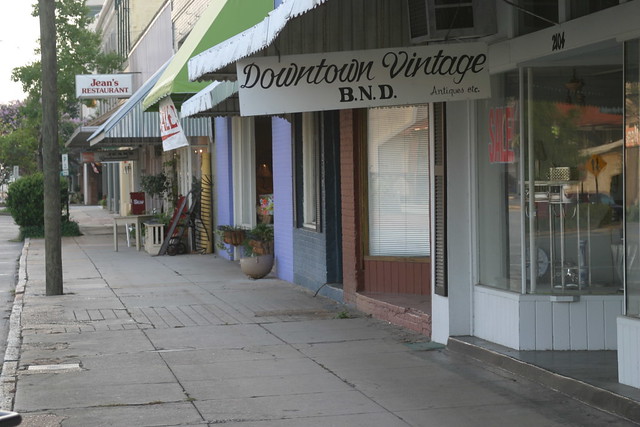
Her description:
Her description:
Front Street Meridian, MS
Front Street. Not much left downtown but if you are downtown Meridian
and like old fashioned home cooking, you have to eat at Jean's restaurant.
It's packed at lunchtime, practically a landmark. There are several vintage
and antique shops to poke around in. And Amy's (the purple shop with
the green awning) always has great gift items. I like wandering around
and seeing all of the old buildings being put to good use again.
Saturday, June 16, 2012

Saturday, June 2, 2012
Midnight, Mississippi
Yes, there is a Midnight, Mississippi.
Midnight is an unincorporated community located in Humphreys County, Mississippi. Midnight is approximately 5 miles (8.0 km) north of Louise and 5 miles (8.0 km) southwest of Silver City along Mississippi Highway 149.
Although Midnight is unincorporated, it has a zip code of 39115. Population in 2010 was less than 200 people.
Although Midnight is unincorporated, it has a zip code of 39115. Population in 2010 was less than 200 people.


Tuesday, May 15, 2012
Meridian's Chris Ethridge - Bass Guitar
Nice tribute to a Home Boy, Chris Ethridge.

Gone: 4/23/12. Rest In Peace, Chris. Ave Atque Vale

 |
Chris Ethridge (born 1947 in Meridian, Mississippi) is an American country rock bass guitarist.
Jacky Jack White hosted a tribute to local legend Chris Ethridge at the Sucarnochee Review on July 2, 2010 in the historic Temple Theatre, Meridian, MS. Chris’s mother attended and Chris’s brothers, Tommy and Joey, also musicians, performed with their groups.
Career
Ethridge began playing in local bands in the South before moving to California aged 17, having been spotted in Biloxi. He played with Joel Scott Hill before joining Gram Parsons in ISB. He played with Parsons after the end of ISB, and again after Parsons left The Byrds, before cofounding the Burrito Brothers with him. He played bass and piano on The Gilded Palace of Sin, but left before Burrito Deluxe. When Parsons left the Burritos, Ethridge played with him again, touring with Byron Berline, Emmylou Harris, Clarence White, Gene Parsons, Sneaky Pete Kleinow, and Roland White.Ethridge left the Burritos again in February 1976, returning to session work. He has been a session musician throughout his career, recording with many leading country-tinged acts, including Judy Collins, Johnny Winter, Ry Cooder, Leon Russell, Randy Newman, Linda Ronstadt,The Byrds and Jackson Browne. He also toured with Willie Nelson's band for almost eight years and later played with the Kudzu Kings.
With the Flying Burrito Brothers. Chris is at the far right. Click on.


Friday, May 11, 2012
Eudora Welty- also a photographer.
Before she was a writer she was a photographer.
Photos are titled: "Sunday Morning", "Underwear" and "Kite"..


More of her work shown here.
Photos are titled: "Sunday Morning", "Underwear" and "Kite"..


More of her work shown here.
Friday, May 4, 2012


Friday, April 6, 2012
Meridian's own, Paul Davis.
1966 or '67 (?)

April 1948 – April 2008 R.I.P.

Singer/songwriter Paul Davis, who had a hit with the 1977 song “I Go Crazy” died in Meridian, MS. on April 22, 2008.
According to his cousin, James Edwards, Davis died of a heart attack at Rush Foundation Hospital. Edwards said Davis had come back to the city he grew up in to retire, after living in New York and Nashville.
Davis also had hits with "A Little Bit Of Soap", "65 Love Affair", "Sweet Life" and “Ride ‘Em Cowboy.”
Monday, March 26, 2012

Friday, March 9, 2012
Friday, March 2, 2012


Thursday, January 12, 2012
Nelva Court & Restaurant
Click on to enlarge.


Above Nelva photos attribution:
Ginger Brook @deepfriedkudzu.com
"Copyright, DeepFriedKudzu.com.
Used with permission."
"Copyright, DeepFriedKudzu.com.
Used with permission."
There is little or no information about many of our old places. The Meridian Star is provides very little help. I had to dig to pick up these diary entries from a dead lady.
This diary is now the property of Ohio State University.
A LIFE REVEALED:
This diary is now the property of Ohio State University.
A LIFE REVEALED:
THE DIARY OF GLADYS BOLON COOPER
(1939-1989) 345 pages. This is from Volume IV
JANUARY 1,1967 to DECEMBER 31,1975
Page 14
THURSDAY, MARCH 23,1967 Left motel (after breakfast there) at ten 'till seven. Weather like summer, redbuds in bloom. Ate lunch roadside table. I drove 55 miles. Country not very interesting. Drove to Meridan, Mississippi. Stayed at Nelva Hotel, where we stayed last November. $8.50 after Charles told her what AAA listed. She had charged us $9.00. Had dinner at Nelva Restaurant. $1.60.
Page 77
MONDAY, NOVEMBER 18, 1968 Beautiful day. We had breakfast at Ackleys. Margaret packed us a lunch. Left at ten of eight. Got mixed up and drove about 10 miles out of our way. Bought rolls at Birmingham and ate lunch in the parking lot there. I drove 43 miles. Got to Meridian. Motel, Nelva at 4:30. $9.00 and tax. Had been warm driving but heater in motel felt good. Had a good chicken dinner at the Nelva Restaurant! $1.50. $2.36 total.
Page 14
THURSDAY, MARCH 23,1967 Left motel (after breakfast there) at ten 'till seven. Weather like summer, redbuds in bloom. Ate lunch roadside table. I drove 55 miles. Country not very interesting. Drove to Meridan, Mississippi. Stayed at Nelva Hotel, where we stayed last November. $8.50 after Charles told her what AAA listed. She had charged us $9.00. Had dinner at Nelva Restaurant. $1.60.
Page 77
MONDAY, NOVEMBER 18, 1968 Beautiful day. We had breakfast at Ackleys. Margaret packed us a lunch. Left at ten of eight. Got mixed up and drove about 10 miles out of our way. Bought rolls at Birmingham and ate lunch in the parking lot there. I drove 43 miles. Got to Meridian. Motel, Nelva at 4:30. $9.00 and tax. Had been warm driving but heater in motel felt good. Had a good chicken dinner at the Nelva Restaurant! $1.50. $2.36 total.
Subscribe to:
Posts (Atom)

