Wednesday, February 17, 2010

Listen to Caroline Herring

I think she's terrific!


About Her:

Caroline Herring is a Canton, Mississippi-born artist whose music has been hailed for combining traditional folk and bluegrass sounds with striking, original observations of modern life and love. Thoroughly steeped in southern culture, Herring began her music career in Austin, TX, where she released her first album, “Twilight,” and won Best New Artist in both the Austin American Statesman and Austin Chronicle in 2002. Since that time, Herring has built an international following and released three more albums, including the masterpiece “Golden Apples of the Sun.”

The critical acclaim for “Golden Apples of the Sun” firmly supports Herring’s status as one of the top musical artists of her generation. The Oxford American says, “Golden Apples is the album of a woman who has come into her powers as a singer-songwriter, claiming as her stomping ground the territory where folk meets alt-country.” NPR’s All Things Considered interviewed Caroline in January 2010 about the making of the record, and Jim Allen of All Music Guide said the following: “It's not easy being a great folksinger -- Kate Wolf, Linda Thompson, and Iris DeMent are some of the names on the short list, but ‘Golden Apples of the Sun’ makes a strong case for the addition of Caroline Herring.”

Herring’s album “Lantana” (2008) received widespread acclaim as an alt-country masterpiece. The Austin Chronicle proclaimed it to be “the best modern Southern Gothic album since Lucinda Williams’ Sweet Old World,” and NPR named it one of the “ten best folk albums of 2008.” On “Lantana,” Herring writes and sings about a myriad of southern topics, from a character in a Larry Brown novel to the infanticide and racism exposed by the dark and troubled life of Susan Smith. With “Golden Apples of the Sun” Herring stakes out new terrain, exchanging the country-influenced resonance of her previous albums for a sound inspired by the iconic female folk singers and songwriters of the 1960s and 70s.

Caroline Herring lives in Atlanta, with her husband and two young children.


Monday, February 15, 2010

A Classmate Who Has Made a DIfference


Davidson to enter Business Hall of Fame

Local businessman Marty Davidson, chairman of the board of Southern Pipe and Supply Co., Inc., has been selected for induction into the Mississippi Business Hall of Fame.

Southern Pipe & Supply is headquartered in Meridian, and is one of the nation’s largest privately held, independent wholesalers of plumbing and heating and air conditioning materials. It has its roots in a company founded by Davidson’s grandfather in the early 1900's. Davidson began working alongside his father and uncle in the family business at the age of five; his first job was stocking shelves. He has worked for Southern Pipe ever since, holding positions at every level from after-school counter help to branch manager to regional manager before becoming president of the company in 1969 at the age of 28.

Under Davidson’s leadership as president, Southern Pipe grew from a company with four branches in three states to a regional industry leader with 100-plus branches in seven states. The company made significant additions to its list of manufacturers represented and added heating and air conditioning materials to its inventory. In 2003, also under Davidson’s leadership, Southern Pipe introduced its first Southern Bath & Kitchen designer showroom. With 60-plus showrooms, Southern Bath & Kitchen is Southern Pipe’s fastest-growing business.

His induction into the Business Hall of Fame is not the first time Davidson’s business acumen has been recognized. He is a recipient of the Hartley D. Peavey Award for Entrepreneurial Excellence, which is presented annually to one of east Mississippi’s leading businessmen or women. He is also a member of the World Presidents’ Organization, a global organization of current and former chief executive officers with members in more than 70 countries.

Marty is a graduate of Tulane University with a MBA in Business Administration.

A Mississippi Business Journal (4/9/2007) article about
Southern Pipe & Supply Co. Inc.

Among his many other contributions to Meridian, he has established the Linda and Marty Davidson Endowment with the MCC (Meridian Community College)Foundation.

Sunday, February 14, 2010

On the Passing of Kate Griffin – R.I.P.


Kate Griffin Junior High

At the close of the school day on December 18, 2009, the old rusty doors of Kate Griffin Junior High School were bolted and locked. The hallways that just a couple weeks previously echoed with the chatter and laughter of young teens, the slamming of metal lockers and the barks from teachers will now enter the provinces of our fond – but fading memories.

The building has a great deal of history. Thousands and thousands of students passed through its doors, through the unique grouping of 7th, 8th, 9th and 10th grades, on their paths to continued education. On the thousands of journeys through our junior high, many friends were made, some for a lifetime.

The school was named for its first principal, who left a lasting impression on Meridian's educational community.

Former school superintendent Dr. H. M. Ivy, in a short oral history of the school, was remembered as saying, "In Miss Kate Griffin, everyone who came in contact with her had an exemplification of what a life of service means. Every boy, every girl, every teacher, every individual who contacted Miss Kate Griffin was to her the most important individual anywhere at any given time."

Most of the structures that now stand at Kate Griffin were built in the '20's, the '50's, and the last in the'60's. Over its lifetime, the school has housed grades ranging from seven to twelve, and was once a grades nine through twelve senior high school.

Kate Griffin Junior High remembered:

The 7th and 8th grades were considered the
lower division and the 9th and 10th grades were –what else– the upper division. Even though the buildings were joined there was a distinctive division and walking from one division to the other during the school year was frowned upon, an unwritten taboo.

Who doesn’t have a vivid memory of Sylvester T. Pendarvis, the formidable Principal roaming the halls... carrying his paddle.

Click on for a larger view:

Some of the students, mostly boys, rode to school on motor scooters, some rode bikes, others walked and still others rode those damnable yellow buses.
There were dances in the gym, student-held variety shows in the auditorium, and moments caught between classes for short conversations with other students. I remember my years at K.G. as an overall enjoyable, interesting experience.

So long, Kate Griffin Junior High.
Tempus omnia sed memorias privat

Some, but not all, of this is extracted from a Meridian Star announcement about KG's demise.

Wednesday, February 10, 2010

A Song That Mentions Meridian - Redux


"Red Dirt Girl" Emmylou Harris

"I think this was hovering over the highway and I "drove over it." I am very, very inspired by the sound of words, and the names of places are so melodic and beautiful. I was passing through Meridian on my way down to record in New Orleans and that's what started it." — Emmylou


Emmylou is a favorite. At 63 years old, she could still break up a happy home. Yeah, mine. I think it's that she likes dogs, too.

If you know a song that more prominently mentions our hometown, tell me and I'll swap it out. But, for now, "across the line and a little southeast of Meridian".


Great lyrics:
"But one thing they don't tell you about the blues
When you got em
You keep on falling cause there ain't no bottom
There ain't know end."


Complete lyrics for "Red Dirt Girl"

Monday, February 8, 2010

Sowashee Creek

The name Sowashee is Choctaw meaning “Mad River.” The Treaty of Dancing Rabbit signed in 1830 opened the area to white settlers, however for hundreds of years the Native Americans enjoyed the benefits of the Sowashee for maintaining their villages with plenty of large mouth bass and blue gill, drinking water, and all other water needs.

Attribution: Ann McKee, The Meridian Star.

In a meeting in June 2009 according to Mayor Smith, "Though the water was once raw sewage, what you're trying to (currently) pump into Sowashee is water that is as good or better than what is currently in the Sowashee." per The Meridian Star

Photo taken in March 2009
What is this fellow doing? I have no idea.


This old pony truss bridge supposedly spanned Sowashee Creek on the Old Marion-Russell Road... a long time ago. Hard to tell.


Back when this was taken I guess the name was spelled Souwashie or maybe spelling was not the photographer's strong suit.

Sunday, January 31, 2010

Union Station


History;
The Meridian Terminal Company, composed of officers from the Mobile & Ohio, the Southern, the Alabama & Vicksburg, and the New Orleans and Northeastern Railroad lines, was formed to build a new passenger depot. The new depot and railway express agency were completed in August 1906 at a cost of $250,000 and constructed in Mission Revival Style architecture. The original depot construction included a central tower, which was demolished in the late 1940s. Further demolition to Union Station occurred in 1966 when all but the eastern wing of the remaining passenger depot was removed.

Union Station Today:

ARRIVALS

INTERIOR (WAITING ROOM):

In operation for only a short time, Union Station has had a profound impact on the community in numerous ways.
The number of passengers on Amtrak trains, Greyhound buses, and Meridian Transit System buses averages 242,360 per year.
Address:1901 Front Street
Meridian, MS

The station has already encouraged more than $8 million in private investment in the Depot District, including office space, retail shops, a data processing/computer training center , upper-story apartments on the west side of Front Street, two hotels - the Terminal Hotel and the Union Hotel, the newly renovated Rosenbaum condominiums, two restaurants, and vital records storage buildings.

Wednesday, January 27, 2010

Hallelujah

Covered here by Jeff Buckley (1966 – 1997) It sometimes seems only the good die young. He drowned in Memphis... perhaps on purpose.

This is probably my favorite song. It was written by Leonard Cohen and released on his 1984 album (CD) Various Positions. It's been covered by K.D.Lang, John Cale, Kate Voegle, Alison Crowe and many others including Bob Dylan, Bon Jovi and Willie Nelson

Hallelujah Lyrics by Leonard Cohen

If you like the song, check out these other two renditions. I like them all.


Another good cover version sung by Rufus Wainwrght

Wednesday, December 16, 2009

Talley Ho! – a new blog.


Click on this blog: Tally Ho!

Joe B. Stewart has put together a great new place to visit. I find his posts to be fascinating because he shares many of his life's interesting, varied and unique experiences. I think you'll enjoy dropping by.

Sunday, December 13, 2009

Remember Troy Laundry?

Click on for a larger picture.

Attribution: A Meridian photographer who signs his work: Claren 44

Friday, December 11, 2009

Positively 4th Street

Now –

Then –
From 4th Street, looking east, Meridian, Miss. Sysid 91500. Scanned as tiff in 2008/08/13 by MDAH. Credit: Courtesy of the Mississippi Department of Archives and History

Notice that monument in the middle. That's Zehler. It's a monument for a Meridian firefighter. On either side of it are lion heads that spit out water and were used for horses to drink water from. Once horse-transportation became less common, it was moved to Highland Park...

Attribution: A Meridian photographer who signs her work: jennybug 32356

Friday, December 4, 2009

Playing for Change Music


This 1964 Sam Cooke song, A Change Is Gonna Come has been covered by more than 40 notable singers/bands. Here, give a listen to Grandpa Elliot and Clarence Bekker. I think you're in for a treat.


Mystery Train
, written by Sam Phillips and Junior Parker in 1953, has also been covered by more than 30 well-known singers, most notably Elvis Presley in 1955. Listen here to Washboard Chazz and Robert Luti do it their way.

Wednesday, November 25, 2009

Beth Ann Fennelly – more of her poetry


Beth Ann Fennelly, an OA contributor, reads at The Oxford American magazine's 10th anniversary Southern Music Issue release party at Ground Zero Blues Club in Clarksdale, Miss.

In my opinion, Beth Ann Fennelly who teaches at Ole Miss — along with her husband, a fine novelist and short story writer, Tom Franklin — is the best Southern poet of this decade. Her poem, The Kudzu Chronicles, is the best contemporary Southern poem (and I have read a lot of them) out there.

First Warm Day in a College Town

Today is the day the first bare-chested
runners appear, coursing down College Hill
as I drive to campus to teach, hard

not to stare because it’s only February 15,
and though I now live in the South,
I spent my girlhood in frigid Illinois

hunting Easter eggs in snow,
or trick-or-treating in the snow,
an umbrella protecting my cardboard wings,

so now it’s hard not to see these taut colts
as my reward, these yearlings testing the pasture,
hard as they come toward my Nissan

not to turn my head as they pound past,
hard not to angle the mirror
to watch them cruise down my shoulder,

too hard, really, when I await them like crocuses,
search for their shadows
as others do the grounghog’s, and suddenly

here they are, the boys without shirts,
how fleet of foot, how cute their buns, I have made it
again, it is spring.

Hard to recall just now
that these are the torsos of my students,
or my past or future students, who every year

grow one year younger, get one year fewer
of my funny jokes and hip references
to Fletch and Nirvana, which means

some year if they catch me admiring
the hair downing their chests, centering
between their goalposts of hipbones,

then going undercover beneath their shorts,
the thin red or blue nylon shorts, the fabric
of flapping American flags or the rigid sails of boats —

some year, if they catch me admiring, they won’t
grin grins that make me, busted,
grin back — hard to know a spring will come

when I’ll have to train my eyes
on the dash, the fuel gauge nearing empty,
hard to think of that spring, that

distant spring, that very very very
(please God) distant
spring.

This poem opens her 2008 book of poems:

UNMENTIONABLES

Thursday, November 19, 2009

A Lucinda Williams Song

I really like her music. An acquired taste? Maybe. I think the slideshow here is a little too syrupy for me, but with YouTube, you get what you get.

"Something About What Happens When We Talk"

Monday, November 16, 2009

Lauderdale County Courthouse

NATIONAL REGISTER OF HISTORIC PLACES - 1979

500 Twenty-first Avenue, Meridian Mississippi
Built Circa 1905; extensively re-modeled in 1939.
Style: Art Deco
P.J. Krouse, Architect

The ten story, brick building has a flat roof of tar composition with cornice, entablature with frieze of Gothic arches, ground floor with five, round arch bays with fixed windows, central, double leaf, wood panel doors, cast iron canopy, base and first floor are stone, first floor with 6/6 double hung sash windows, stringcourse, second-eight floors with 6/6 double hung sash windows, decorative brick consoles over windows with terra cotta diamond motifs, top story with diamond pattern brickwork, three sets of triple 6/6 double hung sash windows with rounded arch, lintels and flanking four 6/6 double hung sash windows with segmented arch lintels.


Saturday, November 7, 2009

Some Original Civil War Photos


Variously referred to as The Civil War by most everyone, but in the South you'll hear it often called as The War Between The States. Oh, and for those "unreconstructed" Southern souls, it's sometimes called The War of Northern Aggression. Your call.

Click on this link:

Wednesday, November 4, 2009

Jackson Pollock - Mural and Picture

The critic Clement Greenberg, Pollock's principal champion, said he took one look at this painting and realized that "Jackson was the greatest painter this country has produced." A Museum of Modern Art curator, the late Kirk Varnedoe, said Mural established Jackson Pollock as the world's premier modern painter.


Decoding Jackson Pollock — Smithsonian Magazine

More Pollock:


Saturday, October 17, 2009

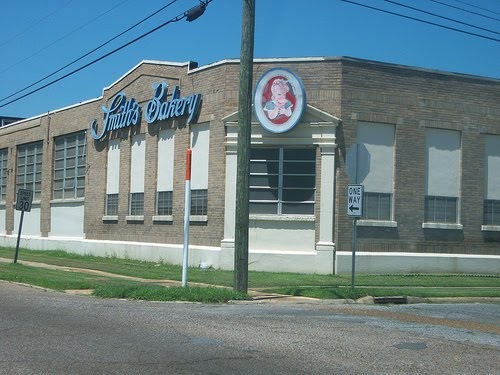
Smith's Bakery

Then:

The photographer reports that this Smith's Sunbeam ad was uncovered when the facade of the old Country Corner was removed during the renovation process.

Now:

Thursday, October 15, 2009

TRIANGLE RESTAURANT


History of the Triangle Restaurant and the
Chik-Steak Sandwich

Most people in Meridian during the decade of the 1930s - the era of the Great Depression – have memories filled with "hard times and little money."

Instead of joining the "down-and-out" crowd, one Meridian couple, Glen and Lillian Phipps, seized upon the time as one of opportunity. The result was that they established a name in the city that would last for years yet to come. The Triangle with its Chik-Steak and Dutch apple pie enjoyed the status of a household word for almost forty years.

It all started during the bleak days of 1931 when the Phipps opened their first restaurant at the corner of Seventh Street and 39th Avenue in what had previously been an automobile battery shop. From 10 AM til midnight they tried to entice enough customers to make a profit at their new venture, but business did not come their way.

Deciding they needed a business within walking distance of downtown trade the Phipps moved in a matter of months to a small vacant restaurant behind Klein's Grocery at Seventh Street and 23rd Avenue. With only a counter and eight stools, Glen decided to increase the seating capacity by four booths. They named it the Triangle Restaurant from the shape of the block and they were ready for business.

Money was scarce during the early '30s. A nickel had to go a long way. Trying to help his customers stretch their nickels led Glen Phipps to search for a five-cent sandwich that would fill. He started off with a piece pork loin, wrapped it in a flour and egg batter and fried it in deep fat, placed his product in a bun with ketchup and a slice of dill pickle, thus was the first Chik-Steak born.

His wife, Lillian, gave it its name from the batter resembling that used for frying chicken and the piece of meat looking much like a small steak.


William Carroll Brookshire – a member of the ice cream making family -enjoyed the distinction of buying the first Chik-Steak, at the suggestion of Glen Phipps. According to the story, Brookshire liked the first one, so he ordered a second. Upon his return to the ice cream plant – about a block away - he told one of the employees of the new taste treat. Whereupon the employee headed for the Triangle and ordered two, not one, of what would become Meridian's five-cent eating sensation.

The Triangle Restaurant and the Chik-Steak became one and synonymous, but there were some growing pains. Glen found he couldn't make a profit because of burning so much of the deep fat in which his sandwich was fried. He then heard of the electric fryer with controlled heat. He promptly went to the Mississippi Power Company, which ordered the Triangle the first electric fryer to come to Meridian.

Then there was the day a customer complained to a car hop that the nickel Chik-Steak was too small for his appetite. The car hop reported that to Phipps who thereupon cooked one twice as large for the customer. Thus was born the Jumbo Chik-Steak which sold for ten cents.

Many Meridianites will also remember other Triangle specialties. There was the aforementioned Dutch apple pie for 10 cents, with cheese for 15 cents. Other Depression favorites included a plate lunch with half a fried chicken for 35 cents.

Not ones to stand still, the Phipps enlarged their restaurant, making the main floor larger and adding a balcony. Eventually, when Klein's Grocery closed, the Triangle moved into that space and changed its entrance to face 23rd Avenue across from the World War I monument.

As financial woes eased, their trade increased. By the time of the late '30s and the early '40s and the opening of Camp Shelby, the Triangle had developed beyond the city's borders. Many a soldier passing through had to stop for a Chik-Steak with all the trimmings.


Back in 1936 the owners of the Triangle had opened a new drive-in restaurant on Eighth Street between 44th and 45th Avenues. They introduced another item that developed a popularity of its own, the five cent malt served in a frosted glass – and the frosted malt was born. Beside their drive-in they built the city's only open-air dance pavilion, complete with a juke box. During the summer other customers sat at nearby tables and feasted on ice-cold watermelon as they watched the dancers. This was the era of the jitterbug with all its athletic antics.

Chik-Steak, the sandwich that first brought the Triangle acclaim, began as a pork tenderloin, but was later made primarily of baby beef. And its popularity continued to grow. To protect his culinary masterpiece, Glen Phipps had its name copyrighted. He sold the copyright to two firms on the Mississippi Gulf Coast, but it never enjoyed the popularity there that it had in the Meridian area.

Mrs. Lillian Phipps, in an interview with the writer, was obviously proud of their unique eating sensation of the Depression era. She, however, was quick to add that much of the success of the Triangle could be attributed to hard work, and that many 12 ad 14 hours days were spent by her and her husband in their restaurant.

Glen Phipps died in 1958. The Triangle continued its popularity under
Mrs. Phipps for another 11 years. In 1969 when her lease came up for another five-year renewal, Mrs. Phipps decided that it was time to leave the restaurant business to the younger generation. For her, it was time for retirement.

Written by Jack Shank, appearing in the Meridian Star March 31, 1985
Mrs. Phipps died May 7, 1998 at the age of 88.

Tuesday, October 13, 2009

Hotel Meridian- Then and Now

Click on for larger pictures.

Then:


The old lobby:


Now:


Obesa cantavit! R.I.P.

Sunday, October 4, 2009

Pigford Building

Click on.

I never knew the legend of the Pigford building, but I'm not familiar with the goings on in Meridian for the past 48 to 50 years. There are folks who think the place is haunted.

Thursday, September 17, 2009

Hewitt Clarke Writes About Meridian


From the Mississippi Writers and Musicians Project
Biography of Hewitt Clarke
By Andy Collins (SHS)

Hewitt Clarke was born in Montgomery, Alabama, on July 7, 1931. He later moved to his father's hometown, Meridian, Mississippi, which was where he grew up. He graduated from Meridian High School and then went on to Ole Miss. While a student at Meridian High School, he wrote for the school newspaper, which is what first got him interested in writing. After graduating from Ole Miss, he became a special agent in the Army Counter Intelligence Corps in Korea and Japan, collecting information about the Communist party. Back home he then started work in the insurance industry, moving many times until he moved to his current home in HoustonTexas.


Book summaries are from Mr. Clarke's web site.

In Mississippi Blood (2008), Mississippi author Hewitt Clarke untangles a web of violence and deceit worthy of any big city crime beat -- anywhere. But that this intrigue unfolds in a sleepy, eastern Mississippi town of fewer than 40,000 souls, makes it even more sensational.

Larry Tiffee, a Meridian, Mississippi real estate developer and country boy from rural Arkansas, is discovered in a pool of his own blood at his posh home overlooking the city early in 1983. Among his other wounds the Coroner notes what appears to be the signature of a professional hit man, a precisely placed, coup-de-grace to Mr. Tiffee's head.

His estranged wife, Gloria, apparently crushed at the loss of her husband with whom, she maintains, she was about to reconcile is questioned and released. But as the hapless killers flee, attempting to lay a paper trail of gasoline purchases and credit card receipts designed to lead authorities astray, their plans run afoul of a task force of police officers and investigators across four states.

The seemingly well thought-out scheme begins to crumble amid allegations of money laundering, illicit drug transactions, and corruption. Next enters the Dixie mafia, an outlaw biker gang called the "Satans" and a 1,000 dollar a day body guard. So complex are the pieces that the case might not have been solved at all, dismissed as a simple burglary gone bad, except for the efforts of a lone private detective.


The East End Tea Room (2005). This is a true story about the citizens of Mississippi weathering the storm in the 1960's when hundreds of civil rights activists from the North invaded the state. It was during a time when black ghettoes in the civil rights worker's own backyards in Northern cities were about to explode in death and destruction. In one year, 67 race riots broke out in Northern cities. In Detroit alone, 43 people were killed and millions of dollars in property destroyed. And the nation may have noticed, but the media never reported, that none of these destructive race riots occurred in the South. 

DNJ:Mr.Clarke wrote three other books: Bloody Kemper (1998), Thunder at Meridian (1995) and War Stories from Mississippi (2004). These are mostly historical and I have not read them. His books are interesting, but in my opinion, he could have benefited greatly from an editor. Some of his narrative tends to drift and dead end. And, there are occasional typos, all of which a good editor could have corrected. He does dig out hard - to - get facts and understands our heritage and culture, but he is too unreconstructed for my tastes. We exchanged a couple of e-mails and he seems to be a delightful fellow with whom I'd like to sit around and have a few drinks.

Monday, September 14, 2009

East Mississippi State Hospital


Date built: 1885
Building Plan: Cottage Plan
Current Status: Active

On March 8, 1882, the Mississippi State Legislature approved enabling legislation to establish the East Mississippi State Insane Asylum. This came about largely due to the efforts of Miss Dorothea Dix, a champion for mentally ill in the United States. The city of Meridian purchased and donated 560 acres of land for the construction of the facility. The asylum opened its doors for service in January of 1885, with a 19 year old man from Meridian as the first patient.

The name of the institution was changed from East Mississippi State Insane Asylum to East Mississippi Insane Hospital in 1898, and finally to East Mississippi State Hospital in the early 1930's, perhaps reflecting changes in attitudes toward the mentally ill nationwide.

During the early years the hospital was almost self sufficient with farming facilities, a hog farm, a cattle farm, a dairy barn, a poultry plant, and orchards of peach, apple, pear and pecan trees. A canning plant was built to process the produce.

In the mid 1950's the hospital realized much progress toward becoming a modern psychiatric hospital. Since its beginning the hospital had provided for only custodial purposes but during the 1950's it began to develop treatment services for the patients. With adequate and well-trained medical and psychiatric staff, the various kinds of therapies and the use of tranquilizing drugs were instituted. The hospital began to be recognized as a successful treatment center of psychiatric illness. It was also during this period that much improvement was made in the physical structures. The Administration Building was remodeled to modern standards and a new occupational therapy building, recreation building, and a new employee dormitory were constructed.

EMSH conducted the practice of Eugenics until 1963.

EMSH Float in the Calf Scramble Parade in the 50s. (click on)

Saturday, August 29, 2009

The Meridian Star

The Meridian Star has served the citizens of East Central Mississippi and West Alabama since its founding as the The Evening Star in 1898. The newspaper was renamed The Meridian Star in 1915 and has served as the city's only daily newspaper since 1921. Currently owned by Community Newspaper Holdings Inc. of Birmingham, Ala., The Meridian Star publishes seven days a week. The newspaper converted from evening to morning delivery in early 2005.


James B. Skewes, whose family bought the paper in the early 1920s, was the editor of the Meridian Star when we were in school and continued as editor into the sixties. (and maybe longer)

I have trouble believing this headline below was printed, but it's written on
the "James Earl Chaney Foundation" website. (scroll to the bottom of the page).

"THE NIGGER WAS FOUND ON TOP" read the August 5, 1964 headlines of the Meridian Star, a local newspaper. While enroute to Meridian, Mississippi the three civil rights workers were stopped by a Neshoba County sheriffs' deputy and turned over to the Ku Klux Klan. They were murdered and their bodies buried in an earthen dam. The 44 day search for their bodies was national and massive. The body of James Chaney was a "mangled mass". The injuries, besides the bullet holes, it was said "could only occur in a high speed airplane crash!"

Whether the above headline is true or not, the below was published in the Meridian Star on January 17, 2009.


It was the best of times, it was the worst of times…

Opening lines of:

A Tale of Two Cities - Charles Dickens

Tuesday, August 25, 2009

Matty Hersee Hospital

The hospital, as we knew it, served mostly the needy, less fortunate among us.


Closure of Matty Hersee Hospital

From and after July 1, 1989, the Matty Hersee Hospital at Meridian shall be closed, and the Legislature shall not appropriate any funds for the operation of this hospital after that date.

Said hospital shall not admit any person as an inpatient into the hospital after June 15, 1989. The hospital shall make every effort to locate and make arrangements with hospitals or other appropriate institutions to provide treatment and care to any patients who will continue to need treatment and care after June 30, 1989.

MATTY HERSEE HOSPITAL
8TH STREET RD
MERIDIAN, MS 39301


Matty Hersee as we remember it in the '50s:

Monday, August 24, 2009

Sunday, August 23, 2009

The Downtown Hallmark

The Threefoot Building was built in 1929 and has 16 stories that tower over downtown Meridian. It was added to the National Register of Historic Places in 1979. I looked around for a while until I found what I thought were more illustrative pictures of this remarkable building, the focal point of Meridian's skyline. It was disheartening to learn of its demise. That this elegant art deco masterpiece is being given new life is fortunate and, of course, an important component to downtown's revitalization. But, that it will become a mid-range Marriott property in its new life is quite a comedown from its former eminence. Click on to enlarge.   


I hope Meridian can generate and maintain sufficient business to support a 125 room Marriott Courtyard property .

Friday, August 21, 2009

Art by Martha Ann Hopkins, neé Markline


Our classmate, Martha Ann, has recently created a blog comprised of her art. I like her work, but asking me to review art is like asking a fish to ride a bicycle, so I'll let Martha Ann speak for herself:

I earned a BFA in Sculpture at the University of Alabama in 2004. I started painting seriously in 2004, and my concerns in painting are the same as they were in sculpture. I start with a minimal look, and then tweak it to provide expression. Rothko and Anish Kapoor have influenced my work. I am using color as expression. Many of my canvases are 3D; I like to respond to an actual shape (other than a flat canvas) with paint.

"Displaced Target" (Acrylic on Shaped Canvas)


"Concert in an Egg" (Unglazed Porcelain)


Visit Martha Ann's Blog by clicking on this link. I think you'll be impressed by her talent(s).