
Thursday, October 22, 2009

Saturday, October 17, 2009
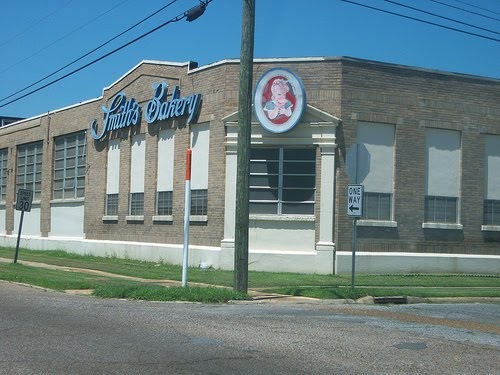
Smith's Bakery
Then:

The photographer reports that this Smith's Sunbeam ad was uncovered when the facade of the old Country Corner was removed during the renovation process.

Now:
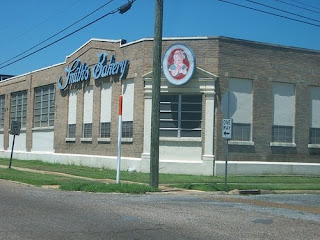

The photographer reports that this Smith's Sunbeam ad was uncovered when the facade of the old Country Corner was removed during the renovation process.

Now:
Thursday, October 15, 2009
TRIANGLE RESTAURANT

History of the Triangle Restaurant and the
Chik-Steak Sandwich
Most people in Meridian during the decade of the 1930s - the era of the Great Depression – have memories filled with "hard times and little money."
Instead of joining the "down-and-out" crowd, one Meridian couple, Glen and Lillian Phipps, seized upon the time as one of opportunity. The result was that they established a name in the city that would last for years yet to come. The Triangle with its Chik-Steak and Dutch apple pie enjoyed the status of a household word for almost forty years.
It all started during the bleak days of 1931 when the Phipps opened their first restaurant at the corner of Seventh Street and 39th Avenue in what had previously been an automobile battery shop. From 10 AM til midnight they tried to entice enough customers to make a profit at their new venture, but business did not come their way.
Deciding they needed a business within walking distance of downtown trade the Phipps moved in a matter of months to a small vacant restaurant behind Klein's Grocery at Seventh Street and 23rd Avenue. With only a counter and eight stools, Glen decided to increase the seating capacity by four booths. They named it the Triangle Restaurant from the shape of the block and they were ready for business.
Money was scarce during the early '30s. A nickel had to go a long way. Trying to help his customers stretch their nickels led Glen Phipps to search for a five-cent sandwich that would fill. He started off with a piece pork loin, wrapped it in a flour and egg batter and fried it in deep fat, placed his product in a bun with ketchup and a slice of dill pickle, thus was the first Chik-Steak born.
His wife, Lillian, gave it its name from the batter resembling that used for frying chicken and the piece of meat looking much like a small steak.
William Carroll Brookshire – a member of the ice cream making family -enjoyed the distinction of buying the first Chik-Steak, at the suggestion of Glen Phipps. According to the story, Brookshire liked the first one, so he ordered a second. Upon his return to the ice cream plant – about a block away - he told one of the employees of the new taste treat. Whereupon the employee headed for the Triangle and ordered two, not one, of what would become Meridian's five-cent eating sensation.
The Triangle Restaurant and the Chik-Steak became one and synonymous, but there were some growing pains. Glen found he couldn't make a profit because of burning so much of the deep fat in which his sandwich was fried. He then heard of the electric fryer with controlled heat. He promptly went to the Mississippi Power Company, which ordered the Triangle the first electric fryer to come to Meridian.
Then there was the day a customer complained to a car hop that the nickel Chik-Steak was too small for his appetite. The car hop reported that to Phipps who thereupon cooked one twice as large for the customer. Thus was born the Jumbo Chik-Steak which sold for ten cents.
Many Meridianites will also remember other Triangle specialties. There was the aforementioned Dutch apple pie for 10 cents, with cheese for 15 cents. Other Depression favorites included a plate lunch with half a fried chicken for 35 cents.
Not ones to stand still, the Phipps enlarged their restaurant, making the main floor larger and adding a balcony. Eventually, when Klein's Grocery closed, the Triangle moved into that space and changed its entrance to face 23rd Avenue across from the World War I monument.
As financial woes eased, their trade increased. By the time of the late '30s and the early '40s and the opening of Camp Shelby, the Triangle had developed beyond the city's borders. Many a soldier passing through had to stop for a Chik-Steak with all the trimmings.
Back in 1936 the owners of the Triangle had opened a new drive-in restaurant on Eighth Street between 44th and 45th Avenues. They introduced another item that developed a popularity of its own, the five cent malt served in a frosted glass – and the frosted malt was born. Beside their drive-in they built the city's only open-air dance pavilion, complete with a juke box. During the summer other customers sat at nearby tables and feasted on ice-cold watermelon as they watched the dancers. This was the era of the jitterbug with all its athletic antics.
Chik-Steak, the sandwich that first brought the Triangle acclaim, began as a pork tenderloin, but was later made primarily of baby beef. And its popularity continued to grow. To protect his culinary masterpiece, Glen Phipps had its name copyrighted. He sold the copyright to two firms on the Mississippi Gulf Coast, but it never enjoyed the popularity there that it had in the Meridian area.
Mrs. Lillian Phipps, in an interview with the writer, was obviously proud of their unique eating sensation of the Depression era. She, however, was quick to add that much of the success of the Triangle could be attributed to hard work, and that many 12 ad 14 hours days were spent by her and her husband in their restaurant.
Glen Phipps died in 1958. The Triangle continued its popularity under
Mrs. Phipps for another 11 years. In 1969 when her lease came up for another five-year renewal, Mrs. Phipps decided that it was time to leave the restaurant business to the younger generation. For her, it was time for retirement.
Written by Jack Shank, appearing in the Meridian Star March 31, 1985
Mrs. Phipps died May 7, 1998 at the age of 88.
Most people in Meridian during the decade of the 1930s - the era of the Great Depression – have memories filled with "hard times and little money."
Instead of joining the "down-and-out" crowd, one Meridian couple, Glen and Lillian Phipps, seized upon the time as one of opportunity. The result was that they established a name in the city that would last for years yet to come. The Triangle with its Chik-Steak and Dutch apple pie enjoyed the status of a household word for almost forty years.
It all started during the bleak days of 1931 when the Phipps opened their first restaurant at the corner of Seventh Street and 39th Avenue in what had previously been an automobile battery shop. From 10 AM til midnight they tried to entice enough customers to make a profit at their new venture, but business did not come their way.
Deciding they needed a business within walking distance of downtown trade the Phipps moved in a matter of months to a small vacant restaurant behind Klein's Grocery at Seventh Street and 23rd Avenue. With only a counter and eight stools, Glen decided to increase the seating capacity by four booths. They named it the Triangle Restaurant from the shape of the block and they were ready for business.
Money was scarce during the early '30s. A nickel had to go a long way. Trying to help his customers stretch their nickels led Glen Phipps to search for a five-cent sandwich that would fill. He started off with a piece pork loin, wrapped it in a flour and egg batter and fried it in deep fat, placed his product in a bun with ketchup and a slice of dill pickle, thus was the first Chik-Steak born.
His wife, Lillian, gave it its name from the batter resembling that used for frying chicken and the piece of meat looking much like a small steak.
William Carroll Brookshire – a member of the ice cream making family -enjoyed the distinction of buying the first Chik-Steak, at the suggestion of Glen Phipps. According to the story, Brookshire liked the first one, so he ordered a second. Upon his return to the ice cream plant – about a block away - he told one of the employees of the new taste treat. Whereupon the employee headed for the Triangle and ordered two, not one, of what would become Meridian's five-cent eating sensation.
The Triangle Restaurant and the Chik-Steak became one and synonymous, but there were some growing pains. Glen found he couldn't make a profit because of burning so much of the deep fat in which his sandwich was fried. He then heard of the electric fryer with controlled heat. He promptly went to the Mississippi Power Company, which ordered the Triangle the first electric fryer to come to Meridian.
Then there was the day a customer complained to a car hop that the nickel Chik-Steak was too small for his appetite. The car hop reported that to Phipps who thereupon cooked one twice as large for the customer. Thus was born the Jumbo Chik-Steak which sold for ten cents.
Many Meridianites will also remember other Triangle specialties. There was the aforementioned Dutch apple pie for 10 cents, with cheese for 15 cents. Other Depression favorites included a plate lunch with half a fried chicken for 35 cents.
Not ones to stand still, the Phipps enlarged their restaurant, making the main floor larger and adding a balcony. Eventually, when Klein's Grocery closed, the Triangle moved into that space and changed its entrance to face 23rd Avenue across from the World War I monument.
As financial woes eased, their trade increased. By the time of the late '30s and the early '40s and the opening of Camp Shelby, the Triangle had developed beyond the city's borders. Many a soldier passing through had to stop for a Chik-Steak with all the trimmings.
Back in 1936 the owners of the Triangle had opened a new drive-in restaurant on Eighth Street between 44th and 45th Avenues. They introduced another item that developed a popularity of its own, the five cent malt served in a frosted glass – and the frosted malt was born. Beside their drive-in they built the city's only open-air dance pavilion, complete with a juke box. During the summer other customers sat at nearby tables and feasted on ice-cold watermelon as they watched the dancers. This was the era of the jitterbug with all its athletic antics.
Chik-Steak, the sandwich that first brought the Triangle acclaim, began as a pork tenderloin, but was later made primarily of baby beef. And its popularity continued to grow. To protect his culinary masterpiece, Glen Phipps had its name copyrighted. He sold the copyright to two firms on the Mississippi Gulf Coast, but it never enjoyed the popularity there that it had in the Meridian area.
Mrs. Lillian Phipps, in an interview with the writer, was obviously proud of their unique eating sensation of the Depression era. She, however, was quick to add that much of the success of the Triangle could be attributed to hard work, and that many 12 ad 14 hours days were spent by her and her husband in their restaurant.
Glen Phipps died in 1958. The Triangle continued its popularity under
Mrs. Phipps for another 11 years. In 1969 when her lease came up for another five-year renewal, Mrs. Phipps decided that it was time to leave the restaurant business to the younger generation. For her, it was time for retirement.
Written by Jack Shank, appearing in the Meridian Star March 31, 1985
Mrs. Phipps died May 7, 1998 at the age of 88.
Tuesday, October 13, 2009
Hotel Meridian- Then and Now
Click on for larger pictures.

The old lobby:

Now:

Obesa cantavit! R.I.P.
Sunday, October 4, 2009
Pigford Building
Click on.

I never knew the legend of the Pigford building, but I'm not familiar with the goings on in Meridian for the past 48 to 50 years. There are folks who think the place is haunted.

I never knew the legend of the Pigford building, but I'm not familiar with the goings on in Meridian for the past 48 to 50 years. There are folks who think the place is haunted.
Thursday, September 17, 2009
Hewitt Clarke Writes About Meridian

From the Mississippi Writers and Musicians Project
Biography of Hewitt Clarke
By Andy Collins (SHS)
Hewitt Clarke was born in Montgomery, Alabama, on July 7, 1931. He later moved to his father's hometown, Meridian, Mississippi, which was where he grew up. He graduated from Meridian High School and then went on to Ole Miss. While a student at Meridian High School, he wrote for the school newspaper, which is what first got him interested in writing. After graduating from Ole Miss, he became a special agent in the Army Counter Intelligence Corps in Korea and Japan, collecting information about the Communist party. Back home he then started work in the insurance industry, moving many times until he moved to his current home in HoustonTexas.

Book summaries are from Mr. Clarke's web site.
In Mississippi Blood (2008), Mississippi author Hewitt Clarke untangles a web of violence and deceit worthy of any big city crime beat -- anywhere. But that this intrigue unfolds in a sleepy, eastern Mississippi town of fewer than 40,000 souls, makes it even more sensational.
Larry Tiffee, a Meridian, Mississippi real estate developer and country boy from rural Arkansas, is discovered in a pool of his own blood at his posh home overlooking the city early in 1983. Among his other wounds the Coroner notes what appears to be the signature of a professional hit man, a precisely placed, coup-de-grace to Mr. Tiffee's head.
His estranged wife, Gloria, apparently crushed at the loss of her husband with whom, she maintains, she was about to reconcile is questioned and released. But as the hapless killers flee, attempting to lay a paper trail of gasoline purchases and credit card receipts designed to lead authorities astray, their plans run afoul of a task force of police officers and investigators across four states.
The seemingly well thought-out scheme begins to crumble amid allegations of money laundering, illicit drug transactions, and corruption. Next enters the Dixie mafia, an outlaw biker gang called the "Satans" and a 1,000 dollar a day body guard. So complex are the pieces that the case might not have been solved at all, dismissed as a simple burglary gone bad, except for the efforts of a lone private detective.
The East End Tea Room (2005). This is a true story about the citizens of Mississippi weathering the storm in the 1960's when hundreds of civil rights activists from the North invaded the state. It was during a time when black ghettoes in the civil rights worker's own backyards in Northern cities were about to explode in death and destruction. In one year, 67 race riots broke out in Northern cities. In Detroit alone, 43 people were killed and millions of dollars in property destroyed. And the nation may have noticed, but the media never reported, that none of these destructive race riots occurred in the South.

Monday, September 14, 2009
East Mississippi State Hospital

Date built: 1885
Building Plan: Cottage Plan
Current Status: Active
On March 8, 1882, the Mississippi State Legislature approved enabling legislation to establish the East Mississippi State Insane Asylum. This came about largely due to the efforts of Miss Dorothea Dix, a champion for mentally ill in the United States. The city of Meridian purchased and donated 560 acres of land for the construction of the facility. The asylum opened its doors for service in January of 1885, with a 19 year old man from Meridian as the first patient.
The name of the institution was changed from East Mississippi State Insane Asylum to East Mississippi Insane Hospital in 1898, and finally to East Mississippi State Hospital in the early 1930's, perhaps reflecting changes in attitudes toward the mentally ill nationwide.
During the early years the hospital was almost self sufficient with farming facilities, a hog farm, a cattle farm, a dairy barn, a poultry plant, and orchards of peach, apple, pear and pecan trees. A canning plant was built to process the produce.
In the mid 1950's the hospital realized much progress toward becoming a modern psychiatric hospital. Since its beginning the hospital had provided for only custodial purposes but during the 1950's it began to develop treatment services for the patients. With adequate and well-trained medical and psychiatric staff, the various kinds of therapies and the use of tranquilizing drugs were instituted. The hospital began to be recognized as a successful treatment center of psychiatric illness. It was also during this period that much improvement was made in the physical structures. The Administration Building was remodeled to modern standards and a new occupational therapy building, recreation building, and a new employee dormitory were constructed.
EMSH conducted the practice of Eugenics until 1963.
EMSH Float in the Calf Scramble Parade in the 50s. (click on)

Saturday, August 29, 2009
The Meridian Star
The Meridian Star has served the citizens of East Central Mississippi and West Alabama since its founding as the The Evening Star in 1898. The newspaper was renamed The Meridian Star in 1915 and has served as the city's only daily newspaper since 1921. Currently owned by Community Newspaper Holdings Inc. of Birmingham, Ala., The Meridian Star publishes seven days a week. The newspaper converted from evening to morning delivery in early 2005.

James B. Skewes, whose family bought the paper in the early 1920s, was the editor of the Meridian Star when we were in school and continued as editor into the sixties. (and maybe longer)
I have trouble believing this headline below was printed, but it's written on
the "James Earl Chaney Foundation" website. (scroll to the bottom of the page).
"THE NIGGER WAS FOUND ON TOP" read the August 5, 1964 headlines of the Meridian Star, a local newspaper. While enroute to Meridian, Mississippi the three civil rights workers were stopped by a Neshoba County sheriffs' deputy and turned over to the Ku Klux Klan. They were murdered and their bodies buried in an earthen dam. The 44 day search for their bodies was national and massive. The body of James Chaney was a "mangled mass". The injuries, besides the bullet holes, it was said "could only occur in a high speed airplane crash!"
It was the best of times, it was the worst of times…
Opening lines of:

James B. Skewes, whose family bought the paper in the early 1920s, was the editor of the Meridian Star when we were in school and continued as editor into the sixties. (and maybe longer)
I have trouble believing this headline below was printed, but it's written on
the "James Earl Chaney Foundation" website. (scroll to the bottom of the page).
"THE NIGGER WAS FOUND ON TOP" read the August 5, 1964 headlines of the Meridian Star, a local newspaper. While enroute to Meridian, Mississippi the three civil rights workers were stopped by a Neshoba County sheriffs' deputy and turned over to the Ku Klux Klan. They were murdered and their bodies buried in an earthen dam. The 44 day search for their bodies was national and massive. The body of James Chaney was a "mangled mass". The injuries, besides the bullet holes, it was said "could only occur in a high speed airplane crash!"
Whether the above headline is true or not, the below was published in the Meridian Star on January 17, 2009.
It was the best of times, it was the worst of times…
Opening lines of:
A Tale of Two Cities - Charles Dickens
Tuesday, August 25, 2009
Matty Hersee Hospital
The hospital, as we knew it, served mostly the needy, less fortunate among us.

Closure of Matty Hersee Hospital
From and after July 1, 1989, the Matty Hersee Hospital at Meridian shall be closed, and the Legislature shall not appropriate any funds for the operation of this hospital after that date.
Said hospital shall not admit any person as an inpatient into the hospital after June 15, 1989. The hospital shall make every effort to locate and make arrangements with hospitals or other appropriate institutions to provide treatment and care to any patients who will continue to need treatment and care after June 30, 1989.
MATTY HERSEE HOSPITAL
8TH STREET RD
MERIDIAN, MS 39301
Matty Hersee as we remember it in the '50s:


Closure of Matty Hersee Hospital
From and after July 1, 1989, the Matty Hersee Hospital at Meridian shall be closed, and the Legislature shall not appropriate any funds for the operation of this hospital after that date.
Said hospital shall not admit any person as an inpatient into the hospital after June 15, 1989. The hospital shall make every effort to locate and make arrangements with hospitals or other appropriate institutions to provide treatment and care to any patients who will continue to need treatment and care after June 30, 1989.
MATTY HERSEE HOSPITAL
8TH STREET RD
MERIDIAN, MS 39301
Matty Hersee as we remember it in the '50s:

Monday, August 24, 2009
Watch out! Th' Boss is gaining on us.
That tempus just keeps on fugit-ing.

From 25 years ago:
Sunday, August 23, 2009
The Downtown Hallmark
The Threefoot Building was built in 1929 and has 16 stories that tower over downtown Meridian. It was added to the National Register of Historic Places in 1979. I looked around for a while until I found what I thought were more illustrative pictures of this remarkable building, the focal point of Meridian's skyline. It was disheartening to learn of its demise. That this elegant art deco masterpiece is being given new life is fortunate and, of course, an important component to downtown's revitalization. But, that it will become a mid-range Marriott property in its new life is quite a comedown from its former eminence. Click on to enlarge.


I hope Meridian can generate and maintain sufficient business to support a 125 room Marriott Courtyard property .


I hope Meridian can generate and maintain sufficient business to support a 125 room Marriott Courtyard property .
Friday, August 21, 2009
Art by Martha Ann Hopkins, neé Markline

Our classmate, Martha Ann, has recently created a blog comprised of her art. I like her work, but asking me to review art is like asking a fish to ride a bicycle, so I'll let Martha Ann speak for herself:
I earned a BFA in Sculpture at the University of Alabama in 2004. I started painting seriously in 2004, and my concerns in painting are the same as they were in sculpture. I start with a minimal look, and then tweak it to provide expression. Rothko and Anish Kapoor have influenced my work. I am using color as expression. Many of my canvases are 3D; I like to respond to an actual shape (other than a flat canvas) with paint.
"Displaced Target" (Acrylic on Shaped Canvas)

"Concert in an Egg" (Unglazed Porcelain)

Visit Martha Ann's Blog by clicking on this link. I think you'll be impressed by her talent(s).
Friday, August 7, 2009
Ripe For Redevelopment?
Note the Threefoot Building towering in the background. Perhaps its conversion to a new purpose foretells this site's future, as well. Let's hope so. Tell me what buildings we are looking at and I'll label the picture as such. Click on for a larger photo

Taken by a photographer who calls himself: toml1969

Taken by a photographer who calls himself: toml1969
Wednesday, August 5, 2009
Remember Vise Clinic?
Click on for a great photo.

Per the photographer who calls himself johnnyurban:
"For whatever reason I was drawn to this 1947 Moderne building in downtown Meridian. After doing some research, it turns out this was the 1st air conditioned building in the state. The wraparound windows are striking, and the contrasting facade depths also add interest. There's a great vertical neon sign on the opposite side of the left white edge that announces the original tenant, the Vise Clinic. The green marble is reminiscent of the Barcleona[sic]* Pavilion by Mies van der Rohe. It feels odd to be admiring these kinds of buildings, but Mid-Century is the new Art Deco in 2009."
*Barcelona (DNJ)

Per the photographer who calls himself johnnyurban:
"For whatever reason I was drawn to this 1947 Moderne building in downtown Meridian. After doing some research, it turns out this was the 1st air conditioned building in the state. The wraparound windows are striking, and the contrasting facade depths also add interest. There's a great vertical neon sign on the opposite side of the left white edge that announces the original tenant, the Vise Clinic. The green marble is reminiscent of the Barcleona[sic]* Pavilion by Mies van der Rohe. It feels odd to be admiring these kinds of buildings, but Mid-Century is the new Art Deco in 2009."
*Barcelona (DNJ)
Friday, July 31, 2009
Mississippi Joined the 20th Century

Here it is now. In Greenville Mississippi. The Juke Joints' character changed forever. Th' fabled Honky Tonks lost some of their lustre. And, what did it leave for the good, honest bootleggers to do?

Thursday, July 30, 2009

Anthem - a reprise.
Bob Dylan's 30th Anniversary - a celebration his music. The oldest guy there? Not me. I think Johnny Cash was.
Recorded in October, 1992 at Madison Square Garden in NYC.
Recorded in October, 1992 at Madison Square Garden in NYC.
Tuesday, July 28, 2009
Causeyville General Store, Causeyville MS.

This general store and gristmill, opened in 1895, is listed on the National Register of Historic Places. Stone ground corn meal is produced on the premises. For more than 90 years, hoop cheese has been sliced for customers on site. The Gristmill operates for the public only on Saturdays. The store also features a musical museum. Free.
From Meridian, MS take Highway 19 South, approximately 7 miles: watch for state highway sign indicating a right turn to Causeyville and follow the signs.
Sunday, July 26, 2009

Friday, July 24, 2009
Those Ubiquitous Five and Dime Stores

S.H. Kress & Co. (1896–1981) was one of the 20th century’s most prosperous variety-store retailers. Though never the largest chain, Kress maintained the highest per-store sales of any five-and-dime retailer.
Growing up, who among us didn't spend most of our meagre allowances on any given Saturday at Kress's, Newberry's or Woolworth's? For me, it was usually after a matinée picture show at the Temple or the Royal.
R.I.P.
S.H. Kress (1896-1981)
J.J. Newberry (1911-1997)
F.W. Woolworth (1878-1997)
and others. They were the precursors to the
big box stores of today: WAL-MART, KMART, etc.

Wednesday, July 22, 2009
Northwood Country Club

Year Built: 1930
Greens Grass Type: Bermuda Grass
Fairways Grass Type: Bermuda Grass
Water Hazards: Yes
Sand Bunkers: 11-20
Yardage Markers: 200, 150, 100 Yard Markers
Northwood Country Club Website
Club Features:
Proshop: On-Site -- Opens at 8:00
Driving Range: Hit from grass
Chipping Green: No
Practice Bunker: No
Guest Policy: Reciprocal
Dress Code: Collared Shirt, No Cutoffs, Denim OK
Reservations: Not Accepted
Food: Full Bar, Beverage Cart, Snack Bar, and Restaurant
Monday, July 20, 2009
Deep Thoughts
From Jack Handey's interstitial segments on Saturday Night Live ( 1991 - 1998)
Before you criticize someone, you should walk a mile in their shoes. That way, when you criticize them, you're a mile away and you have their shoes.
Children need encouragement. If a kid gets an answer right, tell him it was a lucky guess. That way he develops a good, lucky feeling.
If a kid asks where rain comes from, I think a cute thing to tell him is "God is crying." And if he asks why God is crying, another cute thing to tell him is "Probably because of something you did."
The face of a child can say it all, especially the mouth part of the face.
One thing kids like is to be tricked. For instance, I was going to take my little nephew to Disneyland, but instead I drove him to an old burned-out warehouse. "Oh, no," I said. "Disneyland burned down." He cried and cried, but I think that deep down, he thought it was a pretty good joke. I started to drive over to the real Disneyland, but it was getting pretty late.
Maybe in order to understand mankind, we have to look at the word itself: "Mankind". Basically, it's made up of two separate words - "mank" and "ind". What do these words mean ? It's a mystery, and that's why so is mankind.
The memories of my family outings are still a source of strength to me. I remember we'd all pile into the car - I forget what kind it was - and drive and drive. I'm not sure where we'd go, but I think there were some trees there. The smell of something was strong in the air as we played whatever sport we played. I remember a bigger, older guy we called "Dad." We'd eat some stuff, or not, and then I think we went home. I guess some things never leave you.
Before you criticize someone, you should walk a mile in their shoes. That way, when you criticize them, you're a mile away and you have their shoes.
Children need encouragement. If a kid gets an answer right, tell him it was a lucky guess. That way he develops a good, lucky feeling.
If a kid asks where rain comes from, I think a cute thing to tell him is "God is crying." And if he asks why God is crying, another cute thing to tell him is "Probably because of something you did."
The face of a child can say it all, especially the mouth part of the face.
One thing kids like is to be tricked. For instance, I was going to take my little nephew to Disneyland, but instead I drove him to an old burned-out warehouse. "Oh, no," I said. "Disneyland burned down." He cried and cried, but I think that deep down, he thought it was a pretty good joke. I started to drive over to the real Disneyland, but it was getting pretty late.
Maybe in order to understand mankind, we have to look at the word itself: "Mankind". Basically, it's made up of two separate words - "mank" and "ind". What do these words mean ? It's a mystery, and that's why so is mankind.
The memories of my family outings are still a source of strength to me. I remember we'd all pile into the car - I forget what kind it was - and drive and drive. I'm not sure where we'd go, but I think there were some trees there. The smell of something was strong in the air as we played whatever sport we played. I remember a bigger, older guy we called "Dad." We'd eat some stuff, or not, and then I think we went home. I guess some things never leave you.
Friday, July 17, 2009
Tuesday, July 14, 2009
The Three Mile Inn and Court
It should have been placed on the National Register of Historic Places.

The No-Tell Motel
Third Rate Romance - Amazing Rhythm Aces

The No-Tell Motel
Third Rate Romance - Amazing Rhythm Aces
Sunday, July 12, 2009
Used Prose Poem II
Friend's Wife
I will undo you. I will do it single handed like I might a button on a collar. And I will watch you as you, like a collar, spread apart. And I will hear your breath’s soft whistle as you pull the air inside you. And I will know your eyes are closed. And we will.
Afterwards, because we swore we wouldn’t, your expletives will sting like hornets. And again we will swear we won’t again.
Thursday, July 9, 2009
Old U.S. Highway 80 West
From Meridian westward paralleling existing U.S. 80 and Interstate 20 is a pre-1960 section of old U.S. 80. The highway is split into three portions, with one abandoned and two designated as old U.S. 80.
Click on:

Old Section: The easternmost section of this highway is designated at "OLD U.S. Hwy 80." The highway is still open to traffic and is home to homes and businesses in west Meridian. This photo shows a narrow substandard railroad overpass along the route.

Old Section: The easternmost section of this highway is designated at "OLD U.S. Hwy 80." The highway is still open to traffic and is home to homes and businesses in west Meridian. This photo shows a narrow substandard railroad overpass along the route.
Carefree Highway - Gordon Lightfoot
Carefree Highway Lyrics
Tuesday, July 7, 2009
Merchants and Farmers Bank R.I.P.
My first checking account was taken out here. In 1956. I still have that checkbook. I wrote three checks.


Date Established: 04-01-1907
Address: 406 22nd Avenue, Meridian, MS 39301
Date of Deposit Insurance: 01-01-1934
Last Structure Change Effective Date: 12-01-1984
Last Structure Change Process Date: 02-01-1985
Last Structure Change Effective Date: 12-01-1984
Last Structure Change Process Date: 02-01-1985
Status: Inactive
Closing history: Merger - Without Assistance
Closing history: Merger - Without Assistance
Total assets: $168.8 mil
Friday, July 3, 2009
Bronson Road Bridge
The Bronson Bridge constitutes a narrow pony truss bridge across a creek in rural Savoy, Mississippi, 9 miles south of Meridian.


What the hell is a pony truss bridge? One that's built like this:


This bridge is on Bronson Road between Valley Road and Highway 11 near the Savoy community. It will be permanently closed to all traffic this week (9/4/07).
Note: Stuckey's Bridge between Meehan and Savoy will also be permanently closed.
Attribution: Rebecca Benson, a quite talented Meridian photographer.


What the hell is a pony truss bridge? One that's built like this:


This bridge is on Bronson Road between Valley Road and Highway 11 near the Savoy community. It will be permanently closed to all traffic this week (9/4/07).
Note: Stuckey's Bridge between Meehan and Savoy will also be permanently closed.
Attribution: Rebecca Benson, a quite talented Meridian photographer.
Tuesday, June 30, 2009
Bring It On Home To Me
A hat tip to our classmate, Mary Jane (Kelly) Heisterkamp for pointing me to this music so I could post it. Thanks, MJ.
For a little break in the text action, see if you like street singer, Roger Ridley doing a Sam Cooke classic. I think he's great.
This song is supposedly based on a 1955 Gospel version song of the same name by The Staples Singers. Ben E. King wanted The Drifters to record it, but the group's manager rejected it. After leaving The Drifters, King brought it to the legendary songwriting team of Jerry Leiber and Mike Stoller, who gave it a more contemporary sound and polished it into a hit. The bassline at the beginning was Stoller's idea. Many others have covered "Stand By Me" , but give a listen. I like this version by street singer, Roger Ridley and others... much better.
For a little break in the text action, see if you like street singer, Roger Ridley doing a Sam Cooke classic. I think he's great.
This song is supposedly based on a 1955 Gospel version song of the same name by The Staples Singers. Ben E. King wanted The Drifters to record it, but the group's manager rejected it. After leaving The Drifters, King brought it to the legendary songwriting team of Jerry Leiber and Mike Stoller, who gave it a more contemporary sound and polished it into a hit. The bassline at the beginning was Stoller's idea. Many others have covered "Stand By Me" , but give a listen. I like this version by street singer, Roger Ridley and others... much better.
Another Piece Of Meridian's Story
Long, but very interesting, well done chronology — with photos.
From Jack Shank's ,
Meridian, The Queen With A Past, Volume II
Click on:
Meridian Fire Department
( Photos are too small. Sorry! )

This fire occurred on Sunday, March 8, 1964 on Front Street between 22nd Avenue and 23rd Avenue.
Remains of 1964 fire on Front Street as seen from bridge at 22nd Avenue overpass.
From Jack Shank's ,
Meridian, The Queen With A Past, Volume II
Click on:
Meridian Fire Department
( Photos are too small. Sorry! )

This fire occurred on Sunday, March 8, 1964 on Front Street between 22nd Avenue and 23rd Avenue.

Remains of 1964 fire on Front Street as seen from bridge at 22nd Avenue overpass.
Friday, June 26, 2009


Wednesday, June 24, 2009
Loeb's

The Alex Loeb's we grew up with on 5th street.
Loeb's Department Store is a historic specialty boutique department store in Meridian that has remained in the same family for four generations.
The founder, Alex Loeb, was to become a leading merchant in Meridian. He was born in Germany, married Mollie Threefoot, and moved to Meridian from Columbus, Mississippi. He opened his store in Meridian in 1887, selling fine men’s clothing — and only later added womens' and childrens' apparel. The store opened on Johnson Street, and was later moved to a new location on 5th Street.
During Meridian's "golden age" in the early 20th century, it was said that respectable railroad workers would only wear clothes from the Alex Loeb store. The well-dressed Loeb was a colorful character known for his white moustache, ever-present cigar, and hospitable personality; he would personally welcome each customer as he or she entered the store.
During the early 1900s, Loeb's was operated by Alexander M. Loeb's son, A. Marshall Loeb, who graduated from Harvard with an A.B. degree in 1911. The business was eventually passed to A. Marshall Loeb's son, Robert S. Loeb Sr., and his brother Alex Loeb after their graduation from Washington and Lee University in 1939. They also acquired the Marks-Rothenberg Co. department store on 6th Street, and throughout the late 1970s and early 1980s maintained Loeb's as the premier clothier in Mississippi. During the 1980's economic boom, Marks-Rothenberg store was sold to Zale's.
The current Loeb's Inc. is now run by Robert S. Loeb Jr., and continues business today on Front Street in Downtown Meridian.
Loeb's today on Front Street.

Subscribe to:
Posts (Atom)


