For boys and young men growing up in Meridian in our era, the contibutions to our lives on the part of the Davidson Family was huge. When they morphed out of the St. Louis Junk Company the very successful Southern Pipe and Southern Electric Companies, the result to us was that they provided many jobs — when jobs were precious and hard to find — and guidance to those of us who sought to strike out on our own. I have searched in vain to obtain brief biographies of Sammie and Meyer Davidson. Alas, I fear they won’t exist until someone decides to write and publish their remarkable stories.
I personally spent many Saturdays helping Sue Hillis maintain the lighting fixtures in the Southern Electric Showroom. I mounted and electrically connected the fixtures in the dropout mounting “tiles”. I enjoyed the work and, at that young age, I really enjoyed the ‘farmer’s daughter-type” jokes told by the contractors when they dropped by to select fixtures.
In my opinion, Jews were the “glue” that held together many small towns and small cities during our tumultous era. There is an active gentrification effort going on throughout the South, attempting to restore the nature and endearing character of these places back to that that existed before the Walmart-type, big box stores hollowed them out with their outskirts locations.
Are there price differences at the big box stores to add to their customer appeal? Yes, decidedly there are. But, do the store managers know shoppers by their first names and often allow folks to purchase items, knowing full well that the person just lost his— or her — job, but is of good character and will pay for the merchandise... eventually? Don’t bet on it.
This recognition is, in no way, a depreciation of all the others who have made Meridian that pleasant place of which we have fond memories. Many, many people have added a texture and meaning to our town. I just don’t want to let our memory of the large value- added that the Davidsons have made escape mention as we review our past.
I honor the contribution(s) Jews have made to my Meridian, in particular, and Southern life, in general. It is immeasurable. And knowledge of this is indelibly imprinted into my mind.
If you want to learn more about this subject, click on:
Jewish Contributions to our Meridian
I welcome input about other important contributors to our young lives who are no longer around.
Wednesday, May 27, 2009

Saturday, May 23, 2009
Some Who Have Made A Difference

Paul E. Broadhead (10/36 - 8/07)
A native of Needham, Ala., Broadhead lived most of his life in Meridian. In the late 1960s, he founded a small Meridian real estate development company and grew it into what would become one of the nation's Top 10 regional shopping mall developers.
Hartley Peavey, CEO and founder of Peavey Electronics said that he’d lost his best friend when Paul died. “I met him in 1959 at a fraternity party and I've known him ever since”, Peavey said. Peavey said Broadhead was one of the greatest men he’s ever met and one of the most unique and extremely knowledgeable. ”You couldn’t talk about anything he couldn’t talk about”, Peavey said. "When I encountered problems in my professional life and frankly in my personal life, he is who I would turn to, and I'm going to miss him. There was a bond of entrepreneurship Peavey shared with Broadhead as well.
“Entrepreneurs are cut from a little bit different cloth”, Peavey said. He added that his friend was not always popular locally because he called it like was. But, he went on, "Successful people are people who are willing to do the things unsuccessful people don’t want to do, and those are the people who bring home the bacon, whether it is to their own home, throughout a community, a region, a nation or beyond. As human beings the best we can expect to do is help each other", Peavey said. "And Paul Broadhead helped a lot of people”.
Click on to read:
A profile in giving
His philanthropy in the Meridian community is well known through his donation of buildings and founding of numerous organizations including the Meridian Boxing Club, Hilltop House for Boys, Kress Building Youth Center, Friendship Center and the Lauderdale County Juvenile Detention Center, as well as his support of many local charities.
Meridian Museum of Art
For me, this place was the "liberry" until about age 6 when it became the library.
Click on for larger picture

The Little Museum that could, and did,
By Anne McKee
guest columnist, Meridian Star
The invitation dated October 1970 was simply stated, but loudly proclaimed a victory. The long anticipated dream of an arts center for the city of Meridian was realized in the form of a historic building, once having housed the Meridian Public Library, converted into an elegant center for the Meridian arts community.
The history of the arts community in the Meridian area is rich, and historically longstanding, which resulted with the formation of The Meridian Art League in February 1933. The first exhibition featured works of Charles Le Clair, director of the Arts Department at the University of Alabama, and at this period of time, the exhibitions were held at the Lamar Hotel.
In 1949, The League changed its name to the Meridian Art Association and held its first exhibit, under the new name, on the second floor of Marks Rothenberg Company (now the MSU/Riley Performing Arts Building) in March 1949. The show featured thirty paintings from seventeen New Orleans based artists.
Over the next two decades, the Art Association held exhibits, gallery talks, and workshops around the city at various locations, including the Meridian Public Library, The Strand Theatre, Alex Loeb Department Store, First National Bank, Merchants and Farmers Bank, Sears, and the Broadmoor Shopping Center, but the home for most exhibitions were located at Weidmann Restaurant’s, 1870 Room. The first exhibits in the 1870 room were of the work of Caroline Durieux of New Orleans.
And, finally, with the vacancy of the old Carnegie Library building, resulting from the building of a new Meridian Public Library at its present day location, the time came for the Meridian Art Association to have a permanent home gallery. In January 1968, a meeting was held in the conference room of the Carnegie Library, and with great excitement, plans were discussed to renovate the facility into a haven for the Meridian area artists.
As mentioned above, the original structure housing The Meridian Museum of Art first served as The Meridian Public Library, which was a Carnegie Library completed around 1912/1913, and served the Meridian community until 1966/1967, when the current library was constructed. At the time when Library property became available, in 1968, it was agreed by The City of Meridian to convert the building into the arts center. In December 1968, The Meridian Art Association initiated a drive to raise $10,000.00 seed money, to start the museum, and after many hours of concentrated efforts, by many Meridianites, the grand opening was scheduled for January 1970.
Then, the unthinkable happened; a fire severely damaged the facility less than 30 days before the scheduled grand opening.
The date was December 22, 1969. The fire was extensive.The arts community was devastated. Some even doubted if the building would be reconstructed; but that was not the spirit of Meridian and her people.The Meridian City Council ordered immediate rebuilding of the Museum of Art building and within eight months the rebuilding was complete.
The Meridian Museum of Art, now with over five hundred members, continues to lead the way in the Meridian area, providing artistic opportunities for every age group, with each level of technique and design, while blending the new trends with the old favorites.
Click on for larger picture

The Little Museum that could, and did,
By Anne McKee
guest columnist, Meridian Star
The invitation dated October 1970 was simply stated, but loudly proclaimed a victory. The long anticipated dream of an arts center for the city of Meridian was realized in the form of a historic building, once having housed the Meridian Public Library, converted into an elegant center for the Meridian arts community.
The history of the arts community in the Meridian area is rich, and historically longstanding, which resulted with the formation of The Meridian Art League in February 1933. The first exhibition featured works of Charles Le Clair, director of the Arts Department at the University of Alabama, and at this period of time, the exhibitions were held at the Lamar Hotel.
In 1949, The League changed its name to the Meridian Art Association and held its first exhibit, under the new name, on the second floor of Marks Rothenberg Company (now the MSU/Riley Performing Arts Building) in March 1949. The show featured thirty paintings from seventeen New Orleans based artists.
Over the next two decades, the Art Association held exhibits, gallery talks, and workshops around the city at various locations, including the Meridian Public Library, The Strand Theatre, Alex Loeb Department Store, First National Bank, Merchants and Farmers Bank, Sears, and the Broadmoor Shopping Center, but the home for most exhibitions were located at Weidmann Restaurant’s, 1870 Room. The first exhibits in the 1870 room were of the work of Caroline Durieux of New Orleans.
And, finally, with the vacancy of the old Carnegie Library building, resulting from the building of a new Meridian Public Library at its present day location, the time came for the Meridian Art Association to have a permanent home gallery. In January 1968, a meeting was held in the conference room of the Carnegie Library, and with great excitement, plans were discussed to renovate the facility into a haven for the Meridian area artists.
As mentioned above, the original structure housing The Meridian Museum of Art first served as The Meridian Public Library, which was a Carnegie Library completed around 1912/1913, and served the Meridian community until 1966/1967, when the current library was constructed. At the time when Library property became available, in 1968, it was agreed by The City of Meridian to convert the building into the arts center. In December 1968, The Meridian Art Association initiated a drive to raise $10,000.00 seed money, to start the museum, and after many hours of concentrated efforts, by many Meridianites, the grand opening was scheduled for January 1970.
Then, the unthinkable happened; a fire severely damaged the facility less than 30 days before the scheduled grand opening.
The date was December 22, 1969. The fire was extensive.The arts community was devastated. Some even doubted if the building would be reconstructed; but that was not the spirit of Meridian and her people.The Meridian City Council ordered immediate rebuilding of the Museum of Art building and within eight months the rebuilding was complete.
The Meridian Museum of Art, now with over five hundred members, continues to lead the way in the Meridian area, providing artistic opportunities for every age group, with each level of technique and design, while blending the new trends with the old favorites.
Thursday, May 21, 2009
Darryl Vincent and the Flares
Click on for a larger picture
 The following information was generously provided me by the ageless George Cummings. Still rocking after all these years.
Darryl Vincent (1942 - 1975)
The original band on the early records were Darryl, Jimmy Pasquale, Denny Powers and Zack Martin. J Pasquale had to go to camp and I was hired to take his place in '58. After he returned, we went and got a job in Gulf Shores at the Canal Lounge, 5 nites a week. Zack couldn't leave Meridian, so we got Austin Phillips to drum. We got another gig in Mobile at the big Melody Club next to Brookley Field Air force base.The Club seated hundreds of people and we packed it out. Hired 2 black guys to play with us, Eddie Connors on vocals who had a regional hit at the time with" World of Make Believe", great record, I wish I had a copy of it today. Prince Connelly played great blues guitar and sang. We were probably the first integrated band in the South in '58.
Austin had to go back to high school so we got Knobby Walsh to replace him on drums. We loaded up Darryl's Volkswagen bus and drove to Chicago, our first big trip to a large city. We got an audition at Chess Records and they liked us and we cut two songs with Etta James, Larry Williams and Harvey Fuqua of the Moonglows (Etta's husband at the time) singing background vocals.(see below) One song was "Shed No Tears". I can't remember the other one. Because Darryl was already signed to Sandy Records in Mobile caused us some complications and our Chess record was not released.
Remember these? Click on to listen.
Etta James
Larry Williams
Harvey and the Moonglows
Want a tale from the road? I'm sure George, Jimmy and Denny have many, many stories. Maybe a couple could even be told to a mixed audience.
While in Chicago doing the Chess thing we rented a big room with 5 beds across the street from the record company. We were resting one day when the old black maid came in to clean, she told us this room we were staying in was Al Capone's main hotel suite. The next day we went to record and left our bus outside the door of the studio in broad daylight. After hours of recording we came back elated and excited only to find someone had broken into the bus and stolen everything we had brought to Chicago clothes, shoes, luggage, etc. and Jimmy's shotgun he had brought along. Totally wiped us out. Lucky we had left on our instruments and amps inside and they survived. We went and told Leonard Chess ( the owner of the record company) and he wrote us a check for $150. Found out later that they busted a ring of Chicago policemen for breaking into cars.
Darryl used his grandmother's old pistol to close out his gig in '75 at 33 years old.
 The following information was generously provided me by the ageless George Cummings. Still rocking after all these years.
Darryl Vincent (1942 - 1975)
The original band on the early records were Darryl, Jimmy Pasquale, Denny Powers and Zack Martin. J Pasquale had to go to camp and I was hired to take his place in '58. After he returned, we went and got a job in Gulf Shores at the Canal Lounge, 5 nites a week. Zack couldn't leave Meridian, so we got Austin Phillips to drum. We got another gig in Mobile at the big Melody Club next to Brookley Field Air force base.The Club seated hundreds of people and we packed it out. Hired 2 black guys to play with us, Eddie Connors on vocals who had a regional hit at the time with" World of Make Believe", great record, I wish I had a copy of it today. Prince Connelly played great blues guitar and sang. We were probably the first integrated band in the South in '58.
Austin had to go back to high school so we got Knobby Walsh to replace him on drums. We loaded up Darryl's Volkswagen bus and drove to Chicago, our first big trip to a large city. We got an audition at Chess Records and they liked us and we cut two songs with Etta James, Larry Williams and Harvey Fuqua of the Moonglows (Etta's husband at the time) singing background vocals.(see below) One song was "Shed No Tears". I can't remember the other one. Because Darryl was already signed to Sandy Records in Mobile caused us some complications and our Chess record was not released.
Remember these? Click on to listen.
Etta James
Larry Williams
Harvey and the Moonglows
Want a tale from the road? I'm sure George, Jimmy and Denny have many, many stories. Maybe a couple could even be told to a mixed audience.
While in Chicago doing the Chess thing we rented a big room with 5 beds across the street from the record company. We were resting one day when the old black maid came in to clean, she told us this room we were staying in was Al Capone's main hotel suite. The next day we went to record and left our bus outside the door of the studio in broad daylight. After hours of recording we came back elated and excited only to find someone had broken into the bus and stolen everything we had brought to Chicago clothes, shoes, luggage, etc. and Jimmy's shotgun he had brought along. Totally wiped us out. Lucky we had left on our instruments and amps inside and they survived. We went and told Leonard Chess ( the owner of the record company) and he wrote us a check for $150. Found out later that they busted a ring of Chicago policemen for breaking into cars.
Darryl used his grandmother's old pistol to close out his gig in '75 at 33 years old.
Tuesday, May 19, 2009
Brad Watson - Meridian Author

Brad Watson's grandparents, Earl and Maggie Mae, his father, Robert Earl, and his aunt, Margie, lived directly behind me — and across Highway 45N — when I was growing up in Marion. If you remember going into the Vanity Boot Shop, you may have run into Brad (born in 1955) crawling around on the floor being chased around by his mother, Bonnie, Robert Earl's wife. The Watsons owned "Willow Lake", a 25+ acre paradise just north of Marion where I spent a lot of time fishing and learning how to water ski. I've been in touch with Brad via e-mail to congratulate him on his work and to exchange a tidbit of family information.
Brad's first novel: "The Heaven of Mercury" is set in a highly fictionalized Meridian (Mercury=Meridian) with rich images of our hometown. The deeply drawn characters resemble certain folks I think I recognize, but they are presented, as they should be, in such a way as to defy concrete identification. I love his vague, but discretely disguised Threefoot Building. I've read this book twice, enjoying it more the second time through. If you have not done so, I strongly recommend reading it — and his wonderful short stories, too . Brad Watson is a terrific writer. Importantly, he loves dogs and writes about them. That alone made me a fan. You should read his stuff.
He's another homeboy who done done good.
Click on:
If you don't know about him, you should.
A Review of Heaven of Mercury by Southern Scribe
A recent short story by Brad Watson in The New Yorker, "Visitation".
And a thoughtful, insightful review of "Visitation".
Homeboy done done good.
Sam Mockbee - A Meridian Masterpiece

12/1944 - 12/2001- gone, at just 57 years old. A world renowned architect and well-regarded artist
An article written by "Sambo" Mockbee
Emerging Meridian Writer


Mary Miller "lived" in Meridian, Mississippi with her husband and puppy (Now she's single and recently moved to Nashville). She graduated from Mississippi State with a degree in Psychology. And she wrote that she was in graduate school and worked, but not very much, at a children’s shelter.
Mary Miller's short story collection, BIG WORLD, was published by Short Flight/Long Drive Books in February 2009. Though previously known mainly for her pitch-perfect flash fiction, Miller's debut collection of full-length short stories is already receiving some wonderful praise. Kim Chinquee notes that, "Big World is a world of wonder. A powerful collection by an amazing writer." Johnathan Messinger adds in his review for Time Out Chicago that the stories construct a "sense of claustrophobia [that] never lets up." HTMLGIANT is unequivocal in praise, stating simply, "I am, without a doubt, profoundly envious of her work: I wish it were mine." Miller's stories have been published in Black Clock, Mississippi Review, Oxford American, and New Stories from the South 2008, among other places, and more stories are forthcoming in such magazines as McSweeney's Quarterly, Opium, and Versal. She is the author of the chapbook Less Shiny and is an associate editor at Quick Fiction.
Mary Miller's myspace page
Monday, May 18, 2009
Humor in Meridian
From The Outrageous Funny Story Files...
The Best True, Funny Short Stories
A Little Police Action
George Phillips of Meridian, Mississippi was going up to bed when his wife told him that he'd left the light on in the garden shed, which she could see from the bedroom window.
George opened the back door to go turn off the light but saw that there were people in the shed stealing things.
He phoned the police, who asked "Is someone in your house?" and he said "No". Then they said that all patrols were busy, and that he should simply lock his door and an officer would be along when available.
George said, "Okay," hung up, counted to 30, and phoned the police again.
"Hello, I just called you a few seconds ago because there were people in my shed. Well, you don't have to worry about them now cause I've just shot them all." Then he hung up.
Within five minutes three police cars, an Armed Response unit, and an ambulance showed up at the Phillips residence and caught the burglars red-handed.
One of the Policemen said to George: "I thought you said that you'd shot them!"
George said, "I thought you said there was nobody available!" (A True Story - supposedly)
The Best True, Funny Short Stories
A Little Police Action
George Phillips of Meridian, Mississippi was going up to bed when his wife told him that he'd left the light on in the garden shed, which she could see from the bedroom window.
George opened the back door to go turn off the light but saw that there were people in the shed stealing things.
He phoned the police, who asked "Is someone in your house?" and he said "No". Then they said that all patrols were busy, and that he should simply lock his door and an officer would be along when available.
George said, "Okay," hung up, counted to 30, and phoned the police again.
"Hello, I just called you a few seconds ago because there were people in my shed. Well, you don't have to worry about them now cause I've just shot them all." Then he hung up.
Within five minutes three police cars, an Armed Response unit, and an ambulance showed up at the Phillips residence and caught the burglars red-handed.
One of the Policemen said to George: "I thought you said that you'd shot them!"
George said, "I thought you said there was nobody available!" (A True Story - supposedly)
Sunday, May 17, 2009
Martha's Art
Classmate, Martha (Markline) Hopkins is becoming well known among Southern contemporary artists. One of her paintings has been chosen for a juried exhibition at the Montgomery Art Museum. Only 61 works out of 362 submitted were chosen. The juror is the well-regarded contemporary art curator at the Birmingham Museum of Art.
Click to enlarge.
Title: BLACK STRIPE

If you have not done so already, visiting her work on myartspace.com can be a real treat.
Click on: Martha Ann's Homepage
SQUARE STUDY IV
by Classmate, Martha (Markline) Hopkins

Martha Ann told me: "It is 32" X 32" X 3", and created of wooden posts as an exercise in making a sculpture that fits within a square of these measurements. I am interested in minimal lines, but with expression."
Click to enlarge.
Title: BLACK STRIPE

If you have not done so already, visiting her work on myartspace.com can be a real treat.
Click on: Martha Ann's Homepage
SQUARE STUDY IV
by Classmate, Martha (Markline) Hopkins

Martha Ann told me: "It is 32" X 32" X 3", and created of wooden posts as an exercise in making a sculpture that fits within a square of these measurements. I am interested in minimal lines, but with expression."
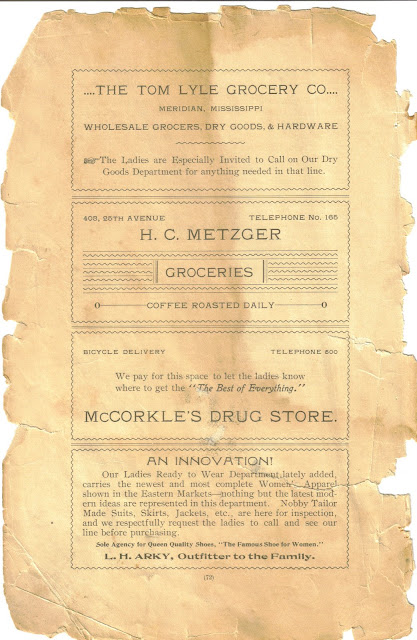
1902 Meridian Cookbook
Probably used a lot of lard back then.
Click on to enlarge. Note the source and also the printer.
Hat tip to Joe B. Stewart for sending me these. Thanks, Joe

Saturday, May 16, 2009
Meridian Phone Book - 1943
More good stuff from Joe Stewart.
Remember your phone number from back then?
Somehow, I remember ours from back in th' 40s.
It was: 2081 J ( letter suffix = party line, I think). My Dad was in the Navy and money was scarce. Click on for a close up.


Thursday, May 14, 2009
Lake Waukaway — Then and Now
Then:

Now

A History of Lake Waukaway
You won’t find it on a map or listed in any travel guides, but Lake Waukaway, Mississippi, located off Clarke County Road 391, a few miles east of Vossburg, is an amazing gem tucked away in the annals of east-central Mississippi history. The Choctaw people who once inhabited the area called the location, Waukaway, due to the coverging of three huge springs. The name translates into “cool and flowing waters”. Following the Choctaw Purchase concluded on September 27, 1830, one of the first European settlers to own the property was a fellow by the name of John Cooley. Some years prior to 1865, Cooley, and others unknown, constructed a combination cotton gin and a gristmill at the site of the abundant springs. Somewhat later, Andrew Jackson McDaniel, who was married to Nancy Ann Cooley, John Cooley’s daughter, acquired the mills from his father-in-law. The property later passed into the hands of a gentleman by the name of Perry.
Around 1929, the Laurel Mississippi Rotary Club purchased the property from Perry and developed it into a recreational site. They also hired Mr. Howard Allen to manage the facility. Six years later, Mr. Allen purchased the facility along with 120 acres of land. Howard Allen operated Lake Waukaway as a family business until 1978. His home was located at the site, upstairs from the offices and concession buildings, and the business was a full time venture for himself, his wife, and their three children. For some forty years, the people of the surrounding communities came to love their excursions to Lake Waukaway as well as their interactions with the Allen family. In the summer days before air conditioning, Waukaway remained open until 10:00 PM, thus allowing many patrons a place to cool down following a long and hot workday.
In addition to swimming, Howard Allen strove to add other Waukaway attractions. Through the years, there were alligators of all sizes on display, white tail deer in a pen, 7-pound striped bass, and a tame school of blue gill bream that would eat out of your hand. During the 1940’s, he sponsored group camps for churches, Boy Scouts, and underprivileged children. Through the 1950’s, a private two-week camp, with an Indian theme, was held. A Choctaw Indian named Cooley Jim was on resident making crafts as well as bows and arrows. The climax came in the form of kids donning Indian costumes and holding a “War Party”. During the 1960’s, participation in these camps came to an end as the various organizations established their own private facilities. In it’s place, a small RV park was added to the eastern area of the lake.
In 1978, Howard Allen passed away. Sadly, the Lake Waukaway that so many of us loved ended as well. The property was sold to Mr. Gene Garrick, who established the site as a christian retreat. Presently, the private facility remains in operation.
A terrific article w/photos about Lake Waukaway - from which the above was edited for length-DNJ
Thanks to Joe B. Stewart for identifying and suggesting this post.

Now

A History of Lake Waukaway
You won’t find it on a map or listed in any travel guides, but Lake Waukaway, Mississippi, located off Clarke County Road 391, a few miles east of Vossburg, is an amazing gem tucked away in the annals of east-central Mississippi history. The Choctaw people who once inhabited the area called the location, Waukaway, due to the coverging of three huge springs. The name translates into “cool and flowing waters”. Following the Choctaw Purchase concluded on September 27, 1830, one of the first European settlers to own the property was a fellow by the name of John Cooley. Some years prior to 1865, Cooley, and others unknown, constructed a combination cotton gin and a gristmill at the site of the abundant springs. Somewhat later, Andrew Jackson McDaniel, who was married to Nancy Ann Cooley, John Cooley’s daughter, acquired the mills from his father-in-law. The property later passed into the hands of a gentleman by the name of Perry.
Around 1929, the Laurel Mississippi Rotary Club purchased the property from Perry and developed it into a recreational site. They also hired Mr. Howard Allen to manage the facility. Six years later, Mr. Allen purchased the facility along with 120 acres of land. Howard Allen operated Lake Waukaway as a family business until 1978. His home was located at the site, upstairs from the offices and concession buildings, and the business was a full time venture for himself, his wife, and their three children. For some forty years, the people of the surrounding communities came to love their excursions to Lake Waukaway as well as their interactions with the Allen family. In the summer days before air conditioning, Waukaway remained open until 10:00 PM, thus allowing many patrons a place to cool down following a long and hot workday.
In addition to swimming, Howard Allen strove to add other Waukaway attractions. Through the years, there were alligators of all sizes on display, white tail deer in a pen, 7-pound striped bass, and a tame school of blue gill bream that would eat out of your hand. During the 1940’s, he sponsored group camps for churches, Boy Scouts, and underprivileged children. Through the 1950’s, a private two-week camp, with an Indian theme, was held. A Choctaw Indian named Cooley Jim was on resident making crafts as well as bows and arrows. The climax came in the form of kids donning Indian costumes and holding a “War Party”. During the 1960’s, participation in these camps came to an end as the various organizations established their own private facilities. In it’s place, a small RV park was added to the eastern area of the lake.
In 1978, Howard Allen passed away. Sadly, the Lake Waukaway that so many of us loved ended as well. The property was sold to Mr. Gene Garrick, who established the site as a christian retreat. Presently, the private facility remains in operation.
A terrific article w/photos about Lake Waukaway - from which the above was edited for length-DNJ
Thanks to Joe B. Stewart for identifying and suggesting this post.
Wednesday, May 13, 2009
Meridian History -Early 20th Century.
Cooper Postcard Collection
Forrest Lamar Cooper, a former Senior Customer Service Agent with Delta Air Lines, sold approximately 4600 color and black-and-white postcards from his personal collection to the Mississippi Department of Archives and History on November 13, 1991. The cards span the years 1892 to 1927.
The MDAH reformatting staff is scanning the cards in the roughly geographical order into which Cooper arranged them. New images of cards will be added to the site as they are completed, until the entire collection is available online.
This remarkable collection includes the devastating tornado of 1906. The extent of the destruction is documented in the latter part of the collection. Perhaps current Meridian residents already know of this wonderful record. No matter, it is a delightful find... for me anyway. Enjoy the 75 , or so, pictures.
Click thru these puppies:
If this is as impressive to the viewing audience as it is to me, y'all owe me "big time."
Monday, May 11, 2009
Another Homeboy Done Done Good

'58 Reverie picture - best close up I found.
 Walk With Wardlow
Originally posted on BLUES-L
Copyright 1999 by Suz ( this is who? Suzanne LeBoeuf ?)
Every once in a while you just hit one of those sweet spots in life. Happened to me last weekend. Along with several others in the Dallas area, I had the chance to spend some time with Gayle Dean Wardlow.
Without going into all the details - I found him to be one of the most endearing people I have met in a long time. I talked with him throughout the weekend about life as well as music. When he speaks - it is with passion, animation and knowledge much more so than that of the "authority" that one might expect (altho there is no mistaking that he is one in his chosen field). His book, "Chasin' That Devil Music" as many of you know, is fascinating in the aspect of documentation of the music he so dearly loves and has spent all his life pursuing.
During the course of our conversations I found out that he was born in Texas :) where his father worked on the oil rig "circuit", moving to Mississippi, and losing that father, at an early age. His initial music fascination was with Roy Acuff. He still has great admiration for the man who allowed a kid with a box full of old Acuff records backstage. They became friends and Roy eventually took him him to some of his different shows. He has many different stories about the houses he visited asking to buy old 78's which years later have accumulated into one of the largest and most valuable collections around.
Gayle also enjoys Western Swing and has a deep knowledge of that genre too. I think he would eventually like to put something together that celebrates its' history and roots. He admits to being able to play guitar, altho humbly so, stating that he cannot play well enough to keep up with any of the professionals. Says he plays best with a dobro flat in his lap :). I watched in fascination as he showed one of Dallas' incredibly talented players where to add another slap or beat to a particular song for that "delta" timing. Also dragged out of him was that he loves to write songs. Hopefully we will be able to hear some of these one day.
A collection of guitars and banjos is growing too. Windows of opportunity in the 78 trade have allowed him to accumulate 50 or 60 to this point and he is always on the lookout for more. (edited for length-DNJ)
Gayle Dean Wardlow is a prolific author of many articles chronicling the Delta Blues and of a book, "Chasin' That Devil Music - Searching for the Blues" that is considered to be the "go to" source to learn about " th' Blues".
An interesting article by Gayle Dean Wardlow: Warning it's long, but good.
Thursday, May 7, 2009
Mardi Gras In Th' Dirt
AKA the "Neshoba County Fair"
Click on for larger pictures

Or, because there are so many sweat-soaked, seersucker-suited politicians giving stump speeches, some of my "enlightened"(progressive) friends might be moved to call it, "Republican Woodstock".
On a twisty stretch of Highway 21 outside Philadelphia, Mississippi, since 1889, the Neshoba County Fair has celebrated the very essence of Southern hospitality (usually the last week in July). For seven days, folks do a lot of eating (fried foods required), drinking (you might find some 'shine), front porch sittin', and late-night pickin'. It's a time to slow down. To forget laptops and cell phones. And to practice the art of conversation and storytelling on a lazy summer day.

For one week in July during the Fair, the fairgrounds operate like a self-contained city. About 600 (difficult to acquire) brightly painted wooden cabins are divided into neighborhoods with names like Founders' Square, Happy Hollow, and Sunset Strip. Trucks drive around making daily ice deliveries (you go through a LOT of ice at the Fair). And there's even a post office on-site, where you can get your own Neshoba County Fair postmark.

Click on for larger pictures

Or, because there are so many sweat-soaked, seersucker-suited politicians giving stump speeches, some of my "enlightened"(progressive) friends might be moved to call it, "Republican Woodstock".
On a twisty stretch of Highway 21 outside Philadelphia, Mississippi, since 1889, the Neshoba County Fair has celebrated the very essence of Southern hospitality (usually the last week in July). For seven days, folks do a lot of eating (fried foods required), drinking (you might find some 'shine), front porch sittin', and late-night pickin'. It's a time to slow down. To forget laptops and cell phones. And to practice the art of conversation and storytelling on a lazy summer day.

For one week in July during the Fair, the fairgrounds operate like a self-contained city. About 600 (difficult to acquire) brightly painted wooden cabins are divided into neighborhoods with names like Founders' Square, Happy Hollow, and Sunset Strip. Trucks drive around making daily ice deliveries (you go through a LOT of ice at the Fair). And there's even a post office on-site, where you can get your own Neshoba County Fair postmark.

Wednesday, May 6, 2009
The Homeboy Done Done Good.
George Cummings
George has got the blues "nailed" — as those of us that got to see and hear him at our reunion can attest. He's still making good music.

Feted at the Sucarnochee Revue
Dr. Rick Young, president of East Mississippi Community College, presents alumnus George Cummings with an honorary diploma from “Scooba Tech.” The tongue-in-cheek presentation came July 18 as Cummings performed onstage in Scooba with the Sucarnochee Revue.
Cummings, a native of Meridian, is best known as a founding member of “Dr. Hook and the Medicine Show,” which recorded hit after hit in the 1970s and 80s – including “Sylvia’s Mother” and “The Cover of the Rolling Stone.” And, just as the song prophesied, Dr. Hook and the Medicine Show was featured on the cover of Rolling Stone magazine in March 1973.
As a teenager, Cummings learned a lot from Jimmie Rodgers’ cousin, Virginia Shine (Hortense Harvey), and was one of the “picking and grinning” musicians who sat up late at her house singing and playing. After high school and a tour of duty as a Marine, Cummings attended EMCC, where he played football and baseball. He was a member of the state championship baseball team in 1958.
Cummings graduated from college and made his way to the New York area in the mid-60s. He has enjoyed a long musical career, and still works from his home in New Jersey – although these days, he said, he also plays a lot of golf.
Note: The Sucarnochee Revue can be heard on numerous commercial and public radio stations across the country. The show airs Saturday nights at 10 p.m. on Alabama Public Radio, and Saturday afternoons on Meridian’s WMOX 1010 AM.
" Cover of the Rolling Stone"
Listen for one of George's solo lines: "I got a freaky ole lady, name a cocaine Katy who embroideries on my jeans. I got my poor ole grey haired daddy drivin' my limousine. "
And, they made it!

George has got the blues "nailed" — as those of us that got to see and hear him at our reunion can attest. He's still making good music.

Feted at the Sucarnochee Revue
Dr. Rick Young, president of East Mississippi Community College, presents alumnus George Cummings with an honorary diploma from “Scooba Tech.” The tongue-in-cheek presentation came July 18 as Cummings performed onstage in Scooba with the Sucarnochee Revue.
Cummings, a native of Meridian, is best known as a founding member of “Dr. Hook and the Medicine Show,” which recorded hit after hit in the 1970s and 80s – including “Sylvia’s Mother” and “The Cover of the Rolling Stone.” And, just as the song prophesied, Dr. Hook and the Medicine Show was featured on the cover of Rolling Stone magazine in March 1973.
As a teenager, Cummings learned a lot from Jimmie Rodgers’ cousin, Virginia Shine (Hortense Harvey), and was one of the “picking and grinning” musicians who sat up late at her house singing and playing. After high school and a tour of duty as a Marine, Cummings attended EMCC, where he played football and baseball. He was a member of the state championship baseball team in 1958.
Cummings graduated from college and made his way to the New York area in the mid-60s. He has enjoyed a long musical career, and still works from his home in New Jersey – although these days, he said, he also plays a lot of golf.
Note: The Sucarnochee Revue can be heard on numerous commercial and public radio stations across the country. The show airs Saturday nights at 10 p.m. on Alabama Public Radio, and Saturday afternoons on Meridian’s WMOX 1010 AM.
" Cover of the Rolling Stone"
Listen for one of George's solo lines: "I got a freaky ole lady, name a cocaine Katy who embroideries on my jeans. I got my poor ole grey haired daddy drivin' my limousine. "
And, they made it!

Tuesday, May 5, 2009


Saturday, May 2, 2009
See Anyone You Remember?
This is an interesting idea by a MHS, class of '54, member. Be sure to follow on to the subsequent pages.(scroll down and, on the left side. as you face the screen. click on "next page") You'll be glad you did. I'm impressed by the work that went into this.
What a well thought out presentation
What a well thought out presentation
Friday, May 1, 2009
Royal Drive-In Theater
Thanks to Lloyd Royal, I fogged a few windows here. You too?
Remember this Screen?

Remember this Entrance?

Remember this Screen?

Remember this Entrance?

Thursday, April 30, 2009
Buckwalter Stadium — Meridian
Former home of the former Meridian Millers baseball team.

Buckwalter Stadium was located in the old fairgrounds of Meridian Mississippi and was the home field of the Meridian Millers who were members of the Southeastern League and the Cotton States League. I don't remember vegetation growing between the slats of the grandstand. The ballpark that preceeded Buckwalter Stadium was named Fairgrounds Field.
The first team to play at the fairgrounds was the Southeastern League's Meridian Scrappers who used the ballpark from 1937-1939. During their first two seasons, they were members of the St. Louis Browns organization. In 1939, they became a co-op team and in 1940, they changed their name to the Meridian Bears. In 1941, they changed their name again, this time to the Meridian Eagles and returned to the St. Louis Browns' umbrella. By 1942 they again were a co-op team. The league ceased operations due to the war after the 1942 season.
In 1946, the Southeastern League returned with the Meridian "Peps", which were members of the Brooklyn Dodgers association. The Peps represented the Dodgers for only one season before switching affiliations to the Cleveland Indians, where they remained from 1947 until 1948. In 1949, the team again went co-op and changed their name for the 5th time. Now, they were known as the Meridian Millers. They remained in the Southeastern League until 1950, when the league finally folded.
With the Class B Southeastern League permanently defunct, the Meridian Millers found themselves without a league to play in, and sat out the 1951 season. In 1952, a spot opened in the Class C Cotton States League, when the Clarksdale Planters ceased operations. Meridian hadn't played in the Cotton States League since 1929. They kept the name Meridian Millers, and instead, changed the name of the stadium from Fairgrounds Field to Buckwalter Stadium. They remained in the Cotton States League as a co-op team until 1955 when they moved to Vicksburg.

Buckwalter Stadium was located in the old fairgrounds of Meridian Mississippi and was the home field of the Meridian Millers who were members of the Southeastern League and the Cotton States League. I don't remember vegetation growing between the slats of the grandstand. The ballpark that preceeded Buckwalter Stadium was named Fairgrounds Field.
The first team to play at the fairgrounds was the Southeastern League's Meridian Scrappers who used the ballpark from 1937-1939. During their first two seasons, they were members of the St. Louis Browns organization. In 1939, they became a co-op team and in 1940, they changed their name to the Meridian Bears. In 1941, they changed their name again, this time to the Meridian Eagles and returned to the St. Louis Browns' umbrella. By 1942 they again were a co-op team. The league ceased operations due to the war after the 1942 season.
In 1946, the Southeastern League returned with the Meridian "Peps", which were members of the Brooklyn Dodgers association. The Peps represented the Dodgers for only one season before switching affiliations to the Cleveland Indians, where they remained from 1947 until 1948. In 1949, the team again went co-op and changed their name for the 5th time. Now, they were known as the Meridian Millers. They remained in the Southeastern League until 1950, when the league finally folded.
With the Class B Southeastern League permanently defunct, the Meridian Millers found themselves without a league to play in, and sat out the 1951 season. In 1952, a spot opened in the Class C Cotton States League, when the Clarksdale Planters ceased operations. Meridian hadn't played in the Cotton States League since 1929. They kept the name Meridian Millers, and instead, changed the name of the stadium from Fairgrounds Field to Buckwalter Stadium. They remained in the Cotton States League as a co-op team until 1955 when they moved to Vicksburg.
Wednesday, April 29, 2009
Peavey's Melody Music Store — R.I.P.
The Last Day

Published: February 24, 2006 06:29 am
Peavey’s Melody Music store shuts its doors today
By Steve Gillespie / assistant editor
The Meridian Star
A downtown business with a history of being a musical haven that spans more than 60 years will close today, February 24, 2006.
The music store was opened in 1945 by J.B. Peavey, father of Peavey Electronics founder and CEO Hartley Peavey. The upstairs of the music store served as Hartley Peavey's first home for Peavey Electronics when he was a young entrepreneur.
In July 2005 the music store's original sign, which had been part of the downtown landscape since 1945, was taken down before it could fall down after being damaged by storms.The sign sported a big cursive "Peavey's," framed by musical notes. Under that, it read "Melody Music Co. Inc." and "Everything Musical."
Pieces of the old sign are still located in the upstairs portion of the store. The establishment was more than a place to buy music or musical instruments and accessories. Many customers came to Peavey's to "escape" and play music.
Many have said ,"It was a business not only built on sales but relationships with customers.It was one of those down-home stores where you came in and didn't leave without telling your life story."
(edited for length-DNJ)
Who, among us, didn't spend time after school hanging out in Peavey's, taking up space while playing and listening to the latest 45s. "Mutt" Peavey was always kind, patient and tolerant with us, Sometimes we even bought a record. Growing up, I loved the damn place.

Published: February 24, 2006 06:29 am
Peavey’s Melody Music store shuts its doors today
By Steve Gillespie / assistant editor
The Meridian Star
A downtown business with a history of being a musical haven that spans more than 60 years will close today, February 24, 2006.
The music store was opened in 1945 by J.B. Peavey, father of Peavey Electronics founder and CEO Hartley Peavey. The upstairs of the music store served as Hartley Peavey's first home for Peavey Electronics when he was a young entrepreneur.
In July 2005 the music store's original sign, which had been part of the downtown landscape since 1945, was taken down before it could fall down after being damaged by storms.The sign sported a big cursive "Peavey's," framed by musical notes. Under that, it read "Melody Music Co. Inc." and "Everything Musical."
Pieces of the old sign are still located in the upstairs portion of the store. The establishment was more than a place to buy music or musical instruments and accessories. Many customers came to Peavey's to "escape" and play music.
Many have said ,"It was a business not only built on sales but relationships with customers.It was one of those down-home stores where you came in and didn't leave without telling your life story."
(edited for length-DNJ)
Who, among us, didn't spend time after school hanging out in Peavey's, taking up space while playing and listening to the latest 45s. "Mutt" Peavey was always kind, patient and tolerant with us, Sometimes we even bought a record. Growing up, I loved the damn place.
Tuesday, April 28, 2009
The Good

RICHARD HARRISON (DICK) TRULY, Vice Admiral, USN
BORN: November 12, 1937
EDUCATION: Attended schools in Fayette and high school in Meridian, Mississippi; received a bachelor of aeronautical engineering degree from Georgia Institute of Technology in 1959.
SPECIAL HONORS: Decorations include the Defense Distinguished Service Medal, Defense Superior Service Medal, two Legion of Merit, Navy Distinguished Flying Cross, and the Meritorious Service Award. His NASA awards include the NASA Distinguished Service Medal, two NASA Space Flight Medals, and two NASA Exceptional Service Medals. He is also the recipient of the Air Force Association’s David C. Shilling Award (1978), Society of Experimental Test Pilot’s Ivan C. Kincheloe Award (1978), the American Astronautical Society’s Flight Achievement Award (1977), the American Institute of Aeronautics and Astronautics Haley Space Flight Award (1980), the Robert H. Goddard Memorial Trophy (1982), the Thomas D. White Space Trophy (1982), the Robert J. Collier Trophy (1982), the Harmon International Trophy (1982), the Federation Aeronautique Internationale Gold Space Medal (1984), the Boy Scouts of America Distinguished Eagle Scout Award , and the Medal of Honor of the National Society of the Daughters of the American Revolution.
Nota Bene:
Dick was my Senior Patrol Leader in Boy Scout Troup 2 which met at the Central Methodist Church in '51 and '52. I was a patrol leader for the Crow patrol. I'm sure I speak for all who knew him when I tell you that he was an inspiring leader to us then — and to the rest of our country later. I find it shameful that I can find nothing about him in the Meridian Star archives.
The Bad

April 6, 1938–September 11, 1999
Wayne Roberts
Alton "Wayne" Roberts was the triggerman who killed Civil Rights workers Schwerner, Goodman, and Chaney on Rock Cut Road on the night of June 21, 1964. He was identified at trial as the killer by fellow Klansman James Jordan, Roberts was convicted, and sentenced to only ten years in prison for killing three people by Federal Judge William Harold Cox. Roberts served only six years of his ten year sentence at the federal penitentiary in Leavenworth, Kansas.
Roberts was a rough and rowdy twenty-six-year-old ex-marine in 1964. He was dishonorably discharged from the marines for fighting, drunkenness, and being absent without leave. He was, by many accounts, "as mean as a junkyard dog." When he returned to Meridian he worked as a car salesman for awhile before opening up a nightclub dancehall called "The Other Place" which he operated in Meridian for several years until his death in 1999.
Roberts began loudly calling for Schwerner's execution soon after joining the Lauderdale County Klan. Roberts was among the Klan members who participated in the beating of blacks at the Mount Zion Church on June 16. He seemed especially proud of his brutal deed, raising his bloody fist in the air as proof of his work.
Even after his arrest as one of nineteen conspirators in December, 1964, Roberts was a man to avoid. After a hearing in 1965, Roberts raced across a courthouse yard to kick a CBS camerman in the groin, then slug him in the head.
by: Douglas O. Linder, Professor
University of Missouri at Kansas City - School of Law
Sunday, April 26, 2009

Saturday, April 25, 2009


Friday, April 24, 2009
Dunn's Falls - Near Enterprise, MS.
The way it used to look.
Click on it to enlarge.

In 1854, John Dunn an Irish immigrant rode his horse into the shallow bed of the Chunky River just north of Enterprise. Dunn, at age thirty-four, had come to America from Ireland at the age of four with his parents. They first settled in North Carolina, then Alabama, and finally East Mississippi. He decided to find a spot to settle in the foothills of the Appalachian Mountain Chain. In 1860, Dunn constructed a three-story frame building for a water-powered cotton factory. The machinery for the mill had been delivered to the Enterprise railroad station when the War Between the States was declared. The Confederate government confiscated Dunn's buildings and machinery, and under Dunn's supervision, the mill was used to manufacture blankets, hats, and knives. During the war, a building was added which housed a blacksmith shop, a distillery and machinery for carding wool used to make soldier's clothing. According to sources, the mill and hat factory continued to operate for many years after the war.
Famed hat maker, John B. Stetson is said to have learned and practiced his trade at Dunn’s Falls.
Click on it to enlarge.

In 1854, John Dunn an Irish immigrant rode his horse into the shallow bed of the Chunky River just north of Enterprise. Dunn, at age thirty-four, had come to America from Ireland at the age of four with his parents. They first settled in North Carolina, then Alabama, and finally East Mississippi. He decided to find a spot to settle in the foothills of the Appalachian Mountain Chain. In 1860, Dunn constructed a three-story frame building for a water-powered cotton factory. The machinery for the mill had been delivered to the Enterprise railroad station when the War Between the States was declared. The Confederate government confiscated Dunn's buildings and machinery, and under Dunn's supervision, the mill was used to manufacture blankets, hats, and knives. During the war, a building was added which housed a blacksmith shop, a distillery and machinery for carding wool used to make soldier's clothing. According to sources, the mill and hat factory continued to operate for many years after the war.
Famed hat maker, John B. Stetson is said to have learned and practiced his trade at Dunn’s Falls.
Wednesday, April 22, 2009


Monday, April 20, 2009
Dentzel Carousel - Highland Park
Our "merry-go-round".
Click on it to enlarge.

The carousel was manufactured in 1896 by Gustav Dentzel of Philadelphia, Pennsylvania, for the 1904 St. Louis Exposition and later sold to the City of Meridian. A cabinet maker by trade, Dentzel was a young German immigrant to the United States. In 1860, he established the Dentzel Factory. His family had manufactured carousels in Germany and offered great support to Gustav's American venture. The Dentzel Factory manufactured two or three carousels per year and supplied parks throughout the East and South.
All of the animals were hand-carved out of poplar or basswood. The carousels often had original oil paintings as well. The arrival of the Great Depression spelled the end to the factory in 1929. The Dentzel Carousel arrived in Meridian in 1909 and has occupied its same location in Highland Park. Its house is the only remaining original carousel building built from a Dentzel blueprint.
Click on it to enlarge.

The carousel was manufactured in 1896 by Gustav Dentzel of Philadelphia, Pennsylvania, for the 1904 St. Louis Exposition and later sold to the City of Meridian. A cabinet maker by trade, Dentzel was a young German immigrant to the United States. In 1860, he established the Dentzel Factory. His family had manufactured carousels in Germany and offered great support to Gustav's American venture. The Dentzel Factory manufactured two or three carousels per year and supplied parks throughout the East and South.
All of the animals were hand-carved out of poplar or basswood. The carousels often had original oil paintings as well. The arrival of the Great Depression spelled the end to the factory in 1929. The Dentzel Carousel arrived in Meridian in 1909 and has occupied its same location in Highland Park. Its house is the only remaining original carousel building built from a Dentzel blueprint.
Sunday, April 19, 2009
Meridian's Gypsy Queen, Callie Mitchell

From the Meridian Star:
Published: April 12, 2007 11:49 pm
A royal burial
By Anne McKee / guest columnist
" The year is 1915 and the sudden death of beloved Gypsy Queen Callie Mitchell brought an estimated 20,000 people to the Deep South and the small southern town of Meridian to attend her funeral and burial.
The Queen of the Gypsies of America and her tribe were camped near Meridian when the Queen died during the delivery of a child. The chance location of a Meridian Funeral home and the Episcopal Church, which was equipped and willing to conduct the services for larger numbers of her people, plus Rose Hill Cemetery, a well-maintained and historic location even in the year of 1915, all played important roles in making the decision.
The Feb. 7, 1915, issue of Meridian Dispatch Newspaper describes the scene. “At one side of the parlors, with candelabra at the head and foot stands the magnificent silver-trimmed metallic casket. Hermetically sealed within, in all the barbaric splendor of a medieval Queen lays Mrs. Callie (Kelly) Mitchell, Queen of the Gypsies of America. Her swarthy face with its high cheekbones is typical of Romany tribes and the head, the upper portion of which is covered with bright silken drapery pinned at the back with pins, rests upon a cushion of filmy silk and satin. The hair is braided Gypsy fashion and the dark tresses shine. The body is attired in a Royal robe of Gypsy Green and other bright colors contrasting vividly with the somber hues usual under such circumstances. Two necklaces are around the neck, one of shells, an heirloom that was descended through generations. The lower part of the body is draped with “Sacred Linen” treasured by Gypsy bands for the use only when death overtakes one of their numbers. When the children arrive, each will put a memento of some kind in the casket and it will devolve upon the youngest child to place her mother’s earrings in the ear.”
Her tribe believed the Queen’s journey into afterlife would require certain items of comfort, such as comb, brush, and other toilet accessories, as well as a supply of clothing for use on the other side of the Styx. Some even thought she was buried with valuable jewels, and perhaps she was?
Members of the Mitchell Tribe, at the time one of the largest in the country, came to Meridian from all parts of the United States to pay tribute: a newsreel was made and exhibited throughout the country relating the mystery and homage paid to a woman of high esteem as she made her final journey to be laid to rest.
The funeral services took place Feb. 12, 1915, and were held at St. Paul’s Episcopal Church, with rector, The Rev. H. W. Wells officiating. On the final day of the Queen’s impressive Romany inspired funeral traditions, more than 5,000 people were at the cemetery to witness the last rites. It was a large and imposing funeral procession that made its way from the undertaking establishment to the Episcopal Church. The local college band headed the procession, followed by male members of the Gypsy band on foot and bareheaded with Chief Mitchell, members of his immediate family and the women and children in carriages. The hearse, with the remains of the Gypsy Queen, headed the carriage procession. The attendance at the church was large…so large that it was impossible for all of the people to gain entrance, so many stood out in the street. The church services were those of the traditional Episcopal Church and were in no way added to by the Gypsies.
This account of a beloved queen and her tragic death has brought thousands of people to her gravesite during the last nearly 100 years since her burial, also bringing gifts to be left on her tombstone. Our curiosity for this glimpse into the early 1900’s and the immense love and respect one woman received from her people still brings many visitors to her grave even until this 21st Century."
Emil Mitchell family story. Warning! It's long, but interesting.
Thursday, April 16, 2009

Wednesday, April 15, 2009

Tuesday, April 14, 2009

Monday, April 13, 2009
The Weidmann's we knew


Since 1870 -- at 210 22nd Avenue. Photo is circa 1953.
Mississippi's oldest restaurant opened with four stools and a counter in 1870. Ignoring for a moment its regionally popular signatures, such as Crab Belvedere, Wiener Schnitzel a la Holstein and Black Bottom Pie, Weidmann's is a marketing landmark in the historical sense.
For example, it is 139 years since Felix Weidmann, a Swiss ocean liner chef, left his kitchen on the open sea and settled in Meridian to create his own taste of the American Dream. "Felix started a tradition here, and we are just carrying it on," said Gloria Chancellor in 1993. She was five generations removed from the original Weidmann. She wistfully remembered growing up in the restaurant with her four sisters.
Traditions, in fact, are so established at Weidmann's that they've become part of the city's official mythology. In Meridian, you know what day it is according to Weidmann's. If they're serving seafood gumbo, it's obviously Friday. This is the sort of stuff marketing stories are built from. Its famous peanut butter is another. The peanut butter tradition began during World War II when butter rationing made it difficult to serve bread with meals. Henry Weidmann, who was then proprietor, took the suggestion of a local customer who said peanut butter and crackers would taste better than nothing.
Saturday, April 11, 2009

Dement Printing Company in business for 134 years in MERIDIAN
It is not a misprint when you see that the founding date of Dement Printing Company is 1875. Five generations of members of the Dement family have been involved in the business that has provided for printing and book publishing needs in East Mississippi for 134 years.
The family actually started in the printing business even before 1875. James Prentiss Dement first learned the trade as an indentured apprentice with W.B. Wallace of Florence, Ala., in 1831. His son, John Joseph Dement decided to follow in his father's trade, and started his own printing business on the second floor of the Lockhard Building on Front Street in 1875.
John Joseph Dement sold the business to his son, John Vance. Later the business was moved to the 2300 block on 4th Street, and John Vance Dement took on his brother, Frank, as a partner. The business began to grow adding one printer and one helper to assist in printing letterheads, envelopes, statements, circulars, order blanks and other odd jobs.
In 1900, the Dements moved down the street to 2315 4th Street, where they stayed for seven years, adding equipment, personnel and a line of office supplies and equipment. In 1909, the Dements built their own shop. The Dement Building is still occupied by the business nearly a hundred years later. Over the years the Dements added on to the building several times, adding a new composing room, press room, offset printing department, bindery, new space for offices and additional space for rentals.
At one point the business that was one of the largest printers in the state covered the entire block except for a portion at the east comer, which was operated as a service station. The staff eventually grew to 70.
"No printing job was too large or too small," said John Dement, current president of the company. "Over the years it has included book binding, ruling, lithographing, photostating, blue prints and rubber stamps as well as trade work for firms in Alabama, Louisiana and Arkansas."
During World War II the company did a lot of work for the military including filling an order for $26,000 worth of carbon paper for Brookley Field in Mobile and another order to print copies of all the blueprints used in the construction of the Air Base at Key Field.
Frank Dement moved to Texas in 1913, selling his share of the business to his brother. John Vance Dement passed away in 1949. All of his seven children, including three sons and four daughters, worked in the business at one time or another.
In 1974 son and present owner John Ernest Dement bought out other family members. Currently his wife, Judy, daughter, Corey, and son, Scott, are involved in the business. Corey and Scott are the fifth generation to be involved in the family business.
The advent of desktop publishing had a major impact on printing businesses such as Dement.
"Computers and copy machines have greatly reduced the amount of printing being done at outside printers," said Dement. "We aren't nearly as big as we were at one time. We're down to about 22 employees. When linotype was used to set type, few could do printing. You had to be in the business for six years before you could even master the trade. But once we went to computers, that opened the door for just about anyone to do printing. You can get a computer and small printer, and you're in business."
One thing the company did to adapt to the changing business was starting a Generations Department that specializes in weddings and babies, making the most special of events treasures on paper. Judy and Corey oversee that side of the business, which Dement says has really taken off. The company also continues to sell a lot of office supplies.
Because not as much space is needed for the printing services, the Dements rent out portions of their building now to a barbershop, travel agency, real estate agency and a bonding company.
If the longevity of employees is a measure, Dement Printing Company must be a great place to work. Many Dement Printing Company employees have stayed for decades. Kleo Blue began as an apprentice bookbinder in 1909, eventually becoming plant superintendent. He had 44 years of service at his death in 1952. Albert Roberts worked as a stock clerk for more than 40 years before passing away. Other employees with more than 30 years experience include the late Clarence Keeton, who was sales manager, and Jube Hancock, city salesman. The late Evelyn Murphy worked for the company for more than 50 years.
Sunday, February 8, 2009
Catching Her Drift
Going to college in Nashville, I had a girlfriend, Lynne Lastname, from Evansville, Indiana. Pretty. Tall, thin, long blonde hair. A “real” blonde. It‘s easy to tell. Anyway, I met her at a SCLC meeting about a month before Kennedy was shot.
On that sad November day, I was reading to a blind student from Kentucky, Larry Lastname, when my roommate, Terry Lastname, walked in and told me the news from Dallas.
Lynne and I spent a lot of time together in late November being pissed off at the senselessness of the assassination and quite depressed along with the rest of the country. I was profoundly affected. So much so, I wrote a short, sophomoric poem:
John is dead.
The world asks,
“Why”?
And Dallas asks,
“Why here?”
In the spring, Lynne moved off campus into an apartment. In the house next door lived a transvestite. His name was Larry. Many evenings, at or near dusk, Larry would prance out on his back patio dressed for an evening out and I guess looking for love. Slinky, almost always in a dark dress, pumps, stockings, well - coifed wig and lots of make-up: red, red lipstick, heavy mascara and eye shadow, etc. We never knew her name.
We used to laugh about it. Lynne said, "There’s a man and woman living next door. We never see them together, though. Strangest thing is they have the same shoe size".
One night, I said, "Imagine what trouble he must go through. I mean shower, probably shave his legs and maybe underarms, put on make-up, shape up and hook up his padded bra, rummage through the closet to find something fetching, check his stockings for runs, pull it all together, dress and go out to find what the evening has to offer... her. Imagine all the effort"
Lynne looked at me with a wry smile and said, "Yeah, just imagine."
On that sad November day, I was reading to a blind student from Kentucky, Larry Lastname, when my roommate, Terry Lastname, walked in and told me the news from Dallas.
Lynne and I spent a lot of time together in late November being pissed off at the senselessness of the assassination and quite depressed along with the rest of the country. I was profoundly affected. So much so, I wrote a short, sophomoric poem:
John is dead.
The world asks,
“Why”?
And Dallas asks,
“Why here?”
In the spring, Lynne moved off campus into an apartment. In the house next door lived a transvestite. His name was Larry. Many evenings, at or near dusk, Larry would prance out on his back patio dressed for an evening out and I guess looking for love. Slinky, almost always in a dark dress, pumps, stockings, well - coifed wig and lots of make-up: red, red lipstick, heavy mascara and eye shadow, etc. We never knew her name.
We used to laugh about it. Lynne said, "There’s a man and woman living next door. We never see them together, though. Strangest thing is they have the same shoe size".
One night, I said, "Imagine what trouble he must go through. I mean shower, probably shave his legs and maybe underarms, put on make-up, shape up and hook up his padded bra, rummage through the closet to find something fetching, check his stockings for runs, pull it all together, dress and go out to find what the evening has to offer... her. Imagine all the effort"
Lynne looked at me with a wry smile and said, "Yeah, just imagine."
Thursday, January 29, 2009

I’m not much good at writing a book review. I’d much rather discuss it with someone who has also read the same thing, but, when I finished reading my pre- release copy – I was given an early heads up by “Book Slut”, a blog I follow — of The Story of Edgar Sawtelle , I became its evangelist, and touted it to everyone who would hold still. I finished the 566 page puppy in early June and since then have given copies as birthday presents (3) and Christmas gifts (4) and prevailed upon seven or eight other folks to read it. Based on their responses I’ve come to realize that there are probably two types of people in the world: those who will love this novel, and those who will hate it. The two opposing camps either say: “ I was up nights late with it, unable to put it down.” ( this was me, too ).
Or:
“To be honest, I hated it. I skipped entire pages of it. The narrative was really boring. He could have cut out half of the pages”. ( its heft alone will prevent many from choosing to read it on a whim. )
I was drawn to Wroblewski’s debut novel for two reasons. First, because dogs play a large part — a large part . The second reason was because I read that the story draws a parallel to Shakespeare’s Hamlet. And so it does. I think to fully enjoy the story’s sensibility one has to believe that dogs are thinking, feeling beings and also accept that the dogs dealt with in the novel are very special, highly intelligent animals. Indeed, Wroblewski goes to great lengths to persuade his readers of these traits, detailing the years spent developing the breed and the grueling hours of training each day it takes to make “a Sawtelle dog". Anyone who can’t accept dogs playing such a large role in a novel of this length isn’t going to be able to stand the book.
Almondine is the dog ( and, interestingly, the Ophelia character ) who nearly raises Edgar (the book’s Hamlet figure). Edgar’s first memory is this:
Between the honey-colored slats of the crib a whiskery muzzle slides forward until its cheeks pull back and a row of dainty front teeth bare themselves in a ridiculous grin.
The nose quivers. The velvet snout dimples... Fine, dark muzzle fur. Black nose, leather of lacework creases, comma of nostrils flexing with each breath... At once, the muzzle he knows is awake. It snorts. Angles right and left. Withdraws. Outside the crib, Almondine’s forequarters appear. Her head is reared back, her ears cocked forward.
A cherry-brindled eye peers back at him.
Whoosh of her tail.
Be still. Stay still.
Much of the novel is like this, simple communication between a boy and a dog. But, there is a complication: Edgar is a mute, so he signs everything to the dogs. The only point in the book where I was tempted to put it away, doubtful that dogs could do such a thing, was when Edgar has the dogs portray the murder of his father, to test his uncle, Claude’s conscience. But, remember this is Hamlet. The play within a play. But acted out by dogs? I was doubtful, but the training of the dogs to do this seemed somewhat plausible, and I willingly let Wroblewski pay the story forward. After all, the dogs memorize a simple sequence:
Roll on your back.
Carry this to the other dog.
Tag that dog.
One aspect of the novel that I feel makes “more” sense than in Shakespeare’s original is the relationship between Trudy ( the Gertrude character ) and Claude ( Claudius ), her deceased husband’s brother. In this story, she’s a complex woman, trying to run a farm on her own in rural Wisconsin in the mid-Twentieth Century. It makes sense for her to accept Claude’s offer to move back to the farm and help her to continue the line of Sawtelle dogs. We get to see far more of the inner workings of this relationship than in Hamlet.
Of course, Wroblewski takes a big risk here. But it’s one that works for me. But I must tell you this: I read much of the book sensing my best friend for eleven years, Joe, my big ol’ black Lab, was reading along with me. The Story of Edgar Sawtelle isn’t for everybody. If you genuinely like dogs and maybe even have pictures of your dog on your desk ... or in your purse or wallet, I think you’ll be delighted with this tale. If not, I don’t know if you’ll make it past the prologue and first chapter. Me? I love dogs. I loved this book. "Saw Tell"(e).
Monday, January 5, 2009
The Kudzu Chronicles — Poetry of the South
By Beth Ann Fennelly. She and her husband, Tom Franklin, a short story writer and novelist, both teach at Ole Miss. In my opinion, Beth Ann Fennelly is the one of — if not the— best poet writing today. Her poems of the South and her life in Mississippi are simply captivating. This video is of her reading an excerpt from "The Kudzu Chronicles", a rather long poem. Contained within the complete poem are references to Faulkner, the Neshoba County Fair and her home in Oxford.
Missionary Work — few folks really like poetry. Some say they do. By clicking on here, you may either read "The Kudzu Chronicles" or, if you prefer, listen to her reading it and discover her for yourself.
The Kudzu Chronicles
Another one:
Souvenir
Click on for more of this superb writer:
Essay

The University
of Mississippi
Department of English
Beth Ann Fennelly
Associate Professor of English
Office: Bondurant W104
Telephone: 662-915-7914
E-mail: bafennel@olemiss.edu
Missionary Work — few folks really like poetry. Some say they do. By clicking on here, you may either read "The Kudzu Chronicles" or, if you prefer, listen to her reading it and discover her for yourself.
The Kudzu Chronicles
Another one:
Souvenir
Click on for more of this superb writer:
Essay

The University
of Mississippi
Department of English
Beth Ann Fennelly
Associate Professor of English
Office: Bondurant W104
Telephone: 662-915-7914
E-mail: bafennel@olemiss.edu
Sunday, January 4, 2009
from the movie: " Pulp Fiction"
At Jack Rabbit Slim's Twist Contest.
John Travolta and Uma Thurman.
Music: Chuck Berry's "You Never Can Tell"
John Travolta and Uma Thurman.
Music: Chuck Berry's "You Never Can Tell"
Sunday, December 28, 2008
Carolina Chocolate Drops
I know I posted this on the "class" blog a few months ago, but, I love these folks.
Monday, December 15, 2008
"Dublin Blues"
I'm really taken with Texas Country Rock.
I think it's the honesty I feel in the lyrics. Maybe it's another acquired taste... like martinis.
I think it's the honesty I feel in the lyrics. Maybe it's another acquired taste... like martinis.
Friday, December 12, 2008
"Crying", Roy Orbison & K.D. Lang
Great song. These two enhance it with one of the best — if not the best —duet treatments of a popular song I've ever heard. When I put this up on the Class of ' 58 blog, I had many positive comments. Movie out takes in the video are from "Hiding Out" a 1987 film with Jon Cryer and Annabeth Gish. Frivolous, but not a bad '80s genre film.
Subscribe to:
Posts (Atom)

